Tag Archives: world religions

Islamic Religious Institutions

Standard

From the Qur’an and the early years of Islamic life, certain religious institutions developed that are almost universally recognized by Muslims.
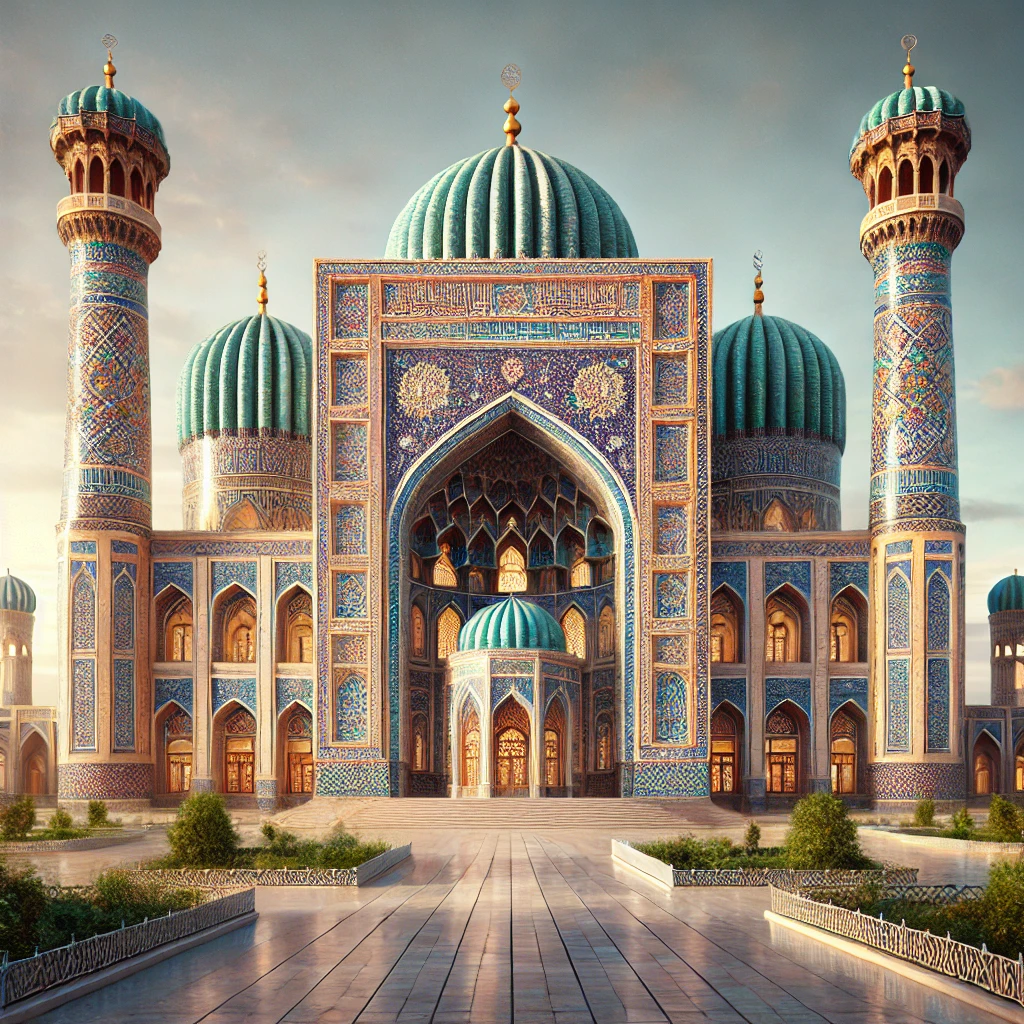
Islam is not a temple-oriented religion. While certain places hold special significance for Muslims, the nomadic lifestyle of the early Arab people would have been incompatible with a requirement to worship in fixed temples. Instead, the nature of their lives necessitated the ability to worship Allah freely and regularly, regardless of location.

As a result, Muslim worship is conducted in a variety of settings, with the mosque serving as a communal gathering place rather than a mandatory site for daily prayers. Prophet Muhammad (ﷺ) designated Friday as a special day for communal worship, paralleling the Sabbath traditions of Jews on Saturday and Christians on Sunday. However, unlike these Sabbaths, Friday is not a day of rest in Islam. Instead, it is the one day of the week when Muslim men are obligated to perform the congregational prayer (Jumu’ah) at the mosque.

During this service, an imam—selected by the community for his knowledge and piety—leads the prayer. The Friday gathering also includes a sermon, or khutbah, which may be delivered in Arabic or the congregation’s native language, addressing spiritual, ethical, or practical matters. Outside of this communal obligation, Muslims are free to fulfill their other religious duties independently, without needing the presence of a mosque or its leadership.
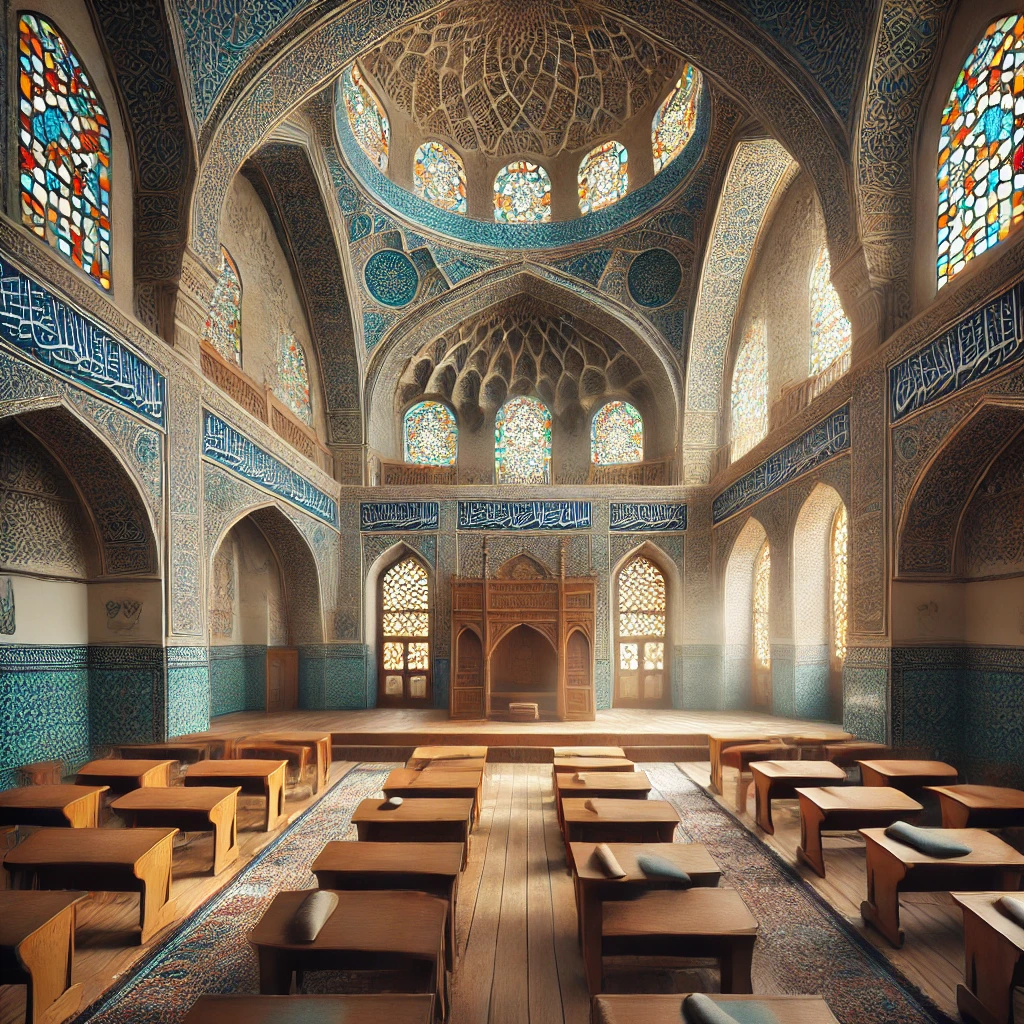
Mosques have historically functioned as schools and libraries, serving as vital centers of learning in the Islamic world. For much of Islamic history, the mosques of Mecca and Medina were among the foremost hubs of religious and intellectual activity. Over time, specialized educational institutions known as madrasas emerged alongside large urban mosques. These schools provided instruction in various disciplines, including Qur’anic recitation and interpretation, Hadith studies, theology, Islamic law (fiqh), and, in many cases, the mystical teachings and practices of Sufism.

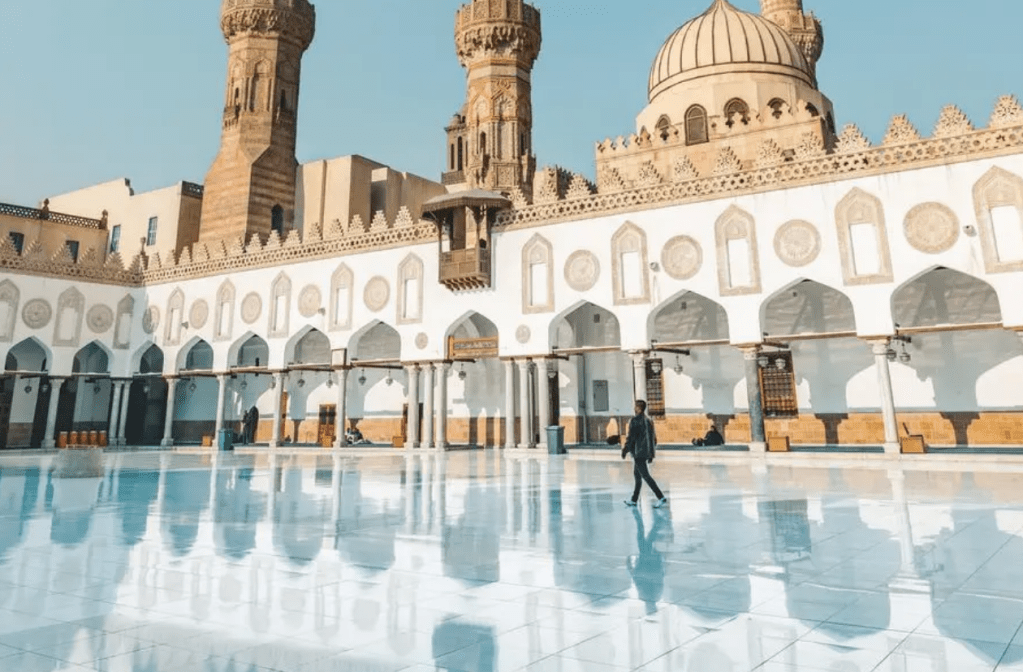
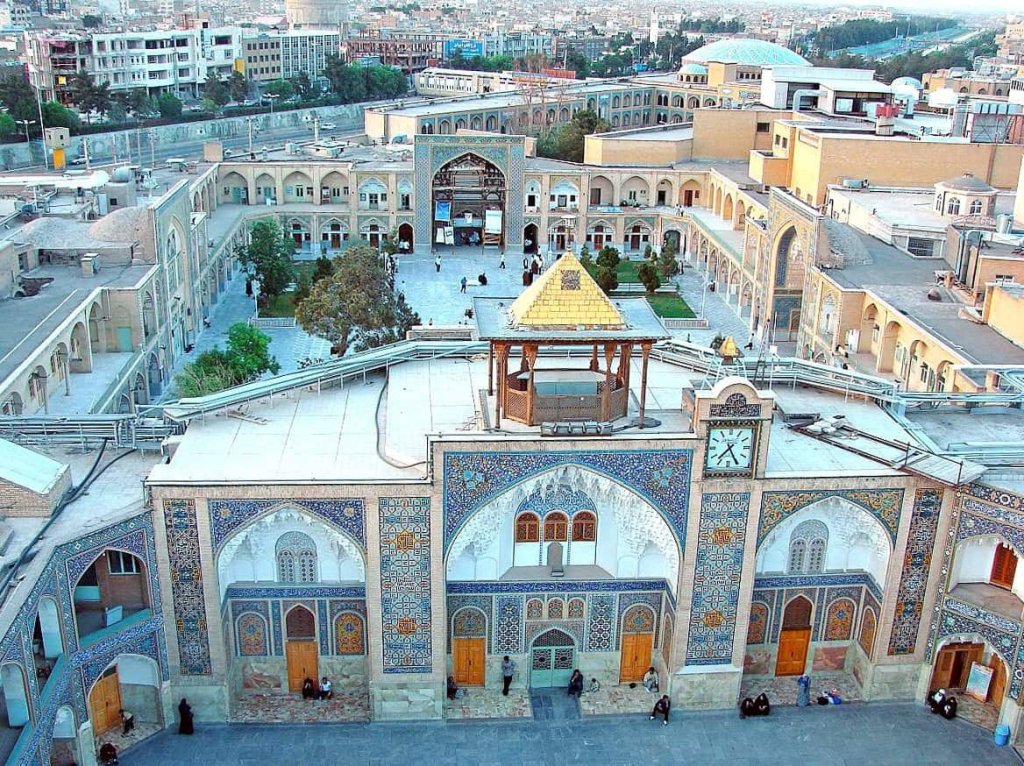
In major centers of Islamic scholarship, numerous madrasas flourished, with some evolving into renowned universities that continue to attract students from across the globe. Among the most famous of these is Al-Azhar University in Cairo, widely regarded as one of the oldest universities in the world. Al-Azhar has long held a central role as the preeminent theological institution in the Sunni Muslim world. Similarly, the city of Qom in Iran is home to distinguished madrasas that serve as leading centers of Shia Islamic learning.
The Nature of God in Islam

Standard
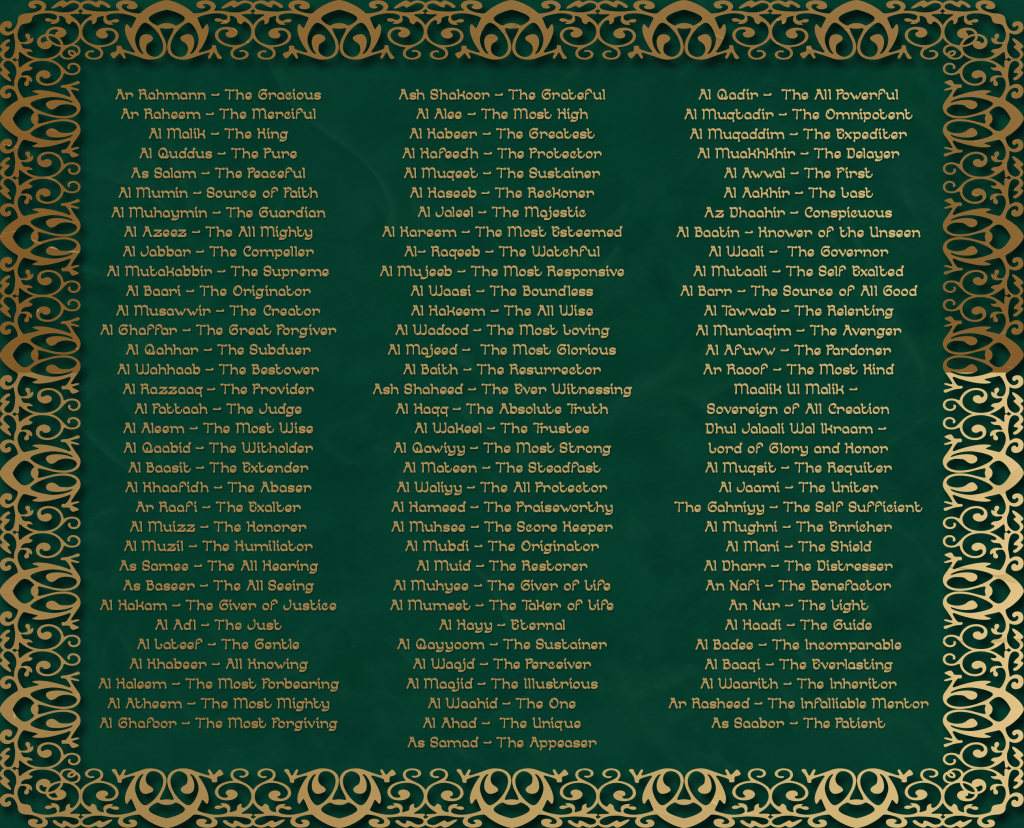
The 99 Names of Allah

Because the Quran is the word of God, its messages are the authority of all Muslims. The religion of Islam demands strict monotheism and that Muslims recognize the oneness of God and that God is the sole creator of everything. Unlike the early polytheists of Mecca and the Byzantine Christians who were in dispute over what part Jesus (ﷺ) played in the Godhead, Muslims believe that there is only one God, complete, eternal, and undivided. Of all the other Religions in the entire world, only Judaism insists on such absolute monotheism.

Quran 112 Al Ikhlas (The Sincerity)

Say: He is God, One,
God, the everlasting Refuge,
Who has not begotten,
And has not been begotten
And equal to Him is none.

Allah (God’s) role as an omnipresent, omniscient, and omnipotent creator of the universe is heavily emphasized in the Quran.

Quran 7:54 (The Heights)

Indeed, your Lord is Allah, Who created the heavens and the earth in six Days, then established Himself on the Throne. He makes the day and night overlap in rapid succession. He created the sun, the moon, and the stars—all subjected to His command. The creation and the command belong to Him ˹alone˺. Blessed is Allah, Lord of all worlds!

According to Muslim tradition, Allah has 99 names. Devout Muslims repeat these names in a manner similar to that of a Roman Catholic reciting the rosary.

Although Allah possesses the characteristics of power, sovereignty, and majesty, Allah is also characterized by justice and mercy. Allah will repay evil with justice, and righteousness with mercy.

The mercy of God is often emphasized in Muslim worship and practice. It is traditional for a Muslim who is giving a speech or writing to begin with the words, ‘In the name of God, the Merciful and Compassionate.’

RELIGION

Standard

The English word ‘religion’ is derived from the Latin word ‘religio,’ which refers to the fear or awe one feels in the presence of a spirit or deity. Most of the religions that have existed have probably been more concerned with humanity’s proper relationship to supernatural beings and pleasing them, rather than with the well being and ethical relationships among people. Ironically, most adherents to religions associate the word ‘religion’ with the word ‘moral,’ but these terms are not actually synonymous.

There is a universality to religion, as wherever people are found, religion is usually found to. Even when we uncover prehistoric civilizations, we usually find altars, cave paintings, and ritualistic burial practices that reveal our religious nature.

Where does religion come from? Some believe that human beings developed religion to make sense of the natural world around them. Some others believe that religion was devised to control and suppress the masses. Another theory is that religion was born out of our psychological fears and/or social needs. Perhaps all these theories are correct.

There are four main theories of religion: the Animistic Theory, the Nature Worship Theory, the Theory of the Original Monotheism, and the Magic Theory.

ANIMISTIC THEORY

The animistic theory is an understanding that human beings developed a practice of ancestor worship or veneration, in which one attends the spirits of the dead. It is believed that an awareness of the existence of spirits in nature led to the worship of various aspects of nature: water, trees, stones, etc… Ultimately, this animistic view of the universe produced the polytheistic religions that worshiped sky, earth, and water deities.

NATURE WORSHIP THEORY

It is believed by some anthropologist that some human beings developed religion from their observations of the forces of nature. People became aware of the regularity and predictability of the seasons, the tides, and the phases of the moon. There response to these forces of nature was to personalize them. Thus they gave names to the sun, moon, etc…, and began to weave tales about them which became mythology. Eventually pantheons and religions were developed around these myths.

THE THEORY OF THE ORIGINAL MONOTHEISM

Some anthropologist studied hunter-gatherer/foraging cultures (which are considered in the field to be very similar to oldest forms of human society). It was notable that most known hunter-gatherer cultures have a common belief in a distant high god. Even though their religions may have animistic and polytheistic characteristics, there always seems to be belief in one ‘great’ or ‘superior’ creator god. Usually this high god is understood to be eternal, having omniscience, beneficence, morality, and omnipotence.

THE MAGIC THEORY

Regarding magic theory, it is believed that early human beings attempted to control the natural world through magic. When humans realized that nature could not be controlled with magic, they developed religion instead. This logic seemed to imply that nature can be implored to cooperate. When religion could not manipulate nature either, it is believed that human beings began to turn to science, as they began to understand that nature is operative.

*This page is still under development. Eventually you will be able to click on the buttons bellow and it will take you to a page dedicated to that religion. So keep checking back to see if more pages have been added.*