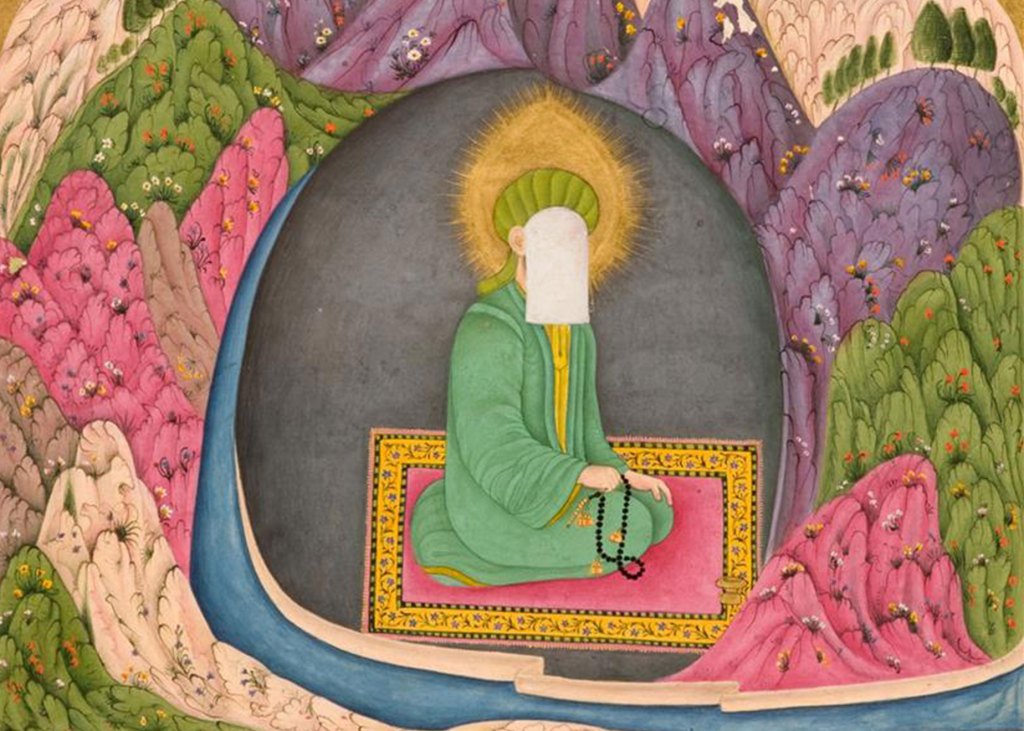
1720 painting of the Prophet Muhammad, titled ‘Prophet Muhammad in the Cave of Hira.’ Paintings and images of any of the prophets is taboo to most Muslims. However, there was a time when Persian, Ottoman, and Mughal artists would paint the Prophet in miniature for personal manuscripts, though a veil was usually used to hide his face.
Born: Around 570 C.E. (Mecca)]
Died: 632 (Medina)
Father: Abdullah Ibn Abd Al-Muttalib
Mother: Amina Bint Wahb
Milk Mother: Halimah bint Abi Dhuayb
Siblings: None
Milk Siblings: 2 milk-brothers, Abd Allah Ibn Al-Harith, Abdullah Al-Harith. 2 milk-sisters, Hothafa Bint Al-Harith, Anissa Bint Al-Harith
Because Islam is one of the youngest of the world’s religions, the details of the life and the founder are more readily available than those of other founders. No one can question that Muhammad (ﷺ) was a historical figure and lived in the 7th century C.E.
Muhammad was born into the clan of Al-Hashim of the Quraysh tribe. The Quraysh tribe controlled the Kaaba in Mecca. Muhammad was orphaned at a very young age. His father died of an illness while his mother was pregnant with him. When Muhammad was an infant, his mother sent him into the desert to be fostered by a Bedouin tribe. This was a custom of the time. Having a milk mother was a sacred tradition. It was believed that growing up in the desert as a semi-nomad was very important for character development. Muhammad was fostered by his milk-mother until he was six years old. Afterwards, he returned to his mother and his own tribe. After he returned, Muhammad went with his mother to visit her family in Yathrib. Shortly after this, Muhammad’s mother died of an illness, leaving Muhammad a young orphan.
After losing both parents, Muhammad joined the household of his uncle, Abu-Talib, who was the chief of the Quraysh tribe. Life for an orphan in the 7th century was difficult. Muhammad was not able to obtain a formal education, and it was noted that Muhammad may have been illiterate or barely literate. This is why Muslims consider the revelation of the Quran to him all the more miraculous. He was not some kind of skilled literary poet, yet suddenly, poetic words started flowing from him.
In the 6th century C.E., the merchants of Mecca controlled the trading caravans that moved between the Indian Ocean and the Mediterranean Sea. This, along with the Kaaba, brought great wealth to Mecca. Muhammad worked and traveled with the caravans. During his travels, he would have come into contact with people from many different cultures and religions. It is assumed he met plenty of Christians, Jews, and Zoroastrians during his travels. Something these three religions had in common was that all believed in one God; and they all had scripture that they believed to be the word of God; and they all believed that the world would end one day, the righteous would be rewarded, and the evil would be punished.
Years as a caravaner most likely taught Muhammad mathematical and business skills. He earned the reputation of being honest, faithful, loyal, and trustworthy. This is probably what afforded Muhammad the opportunity to meet the woman who would become his first wife.
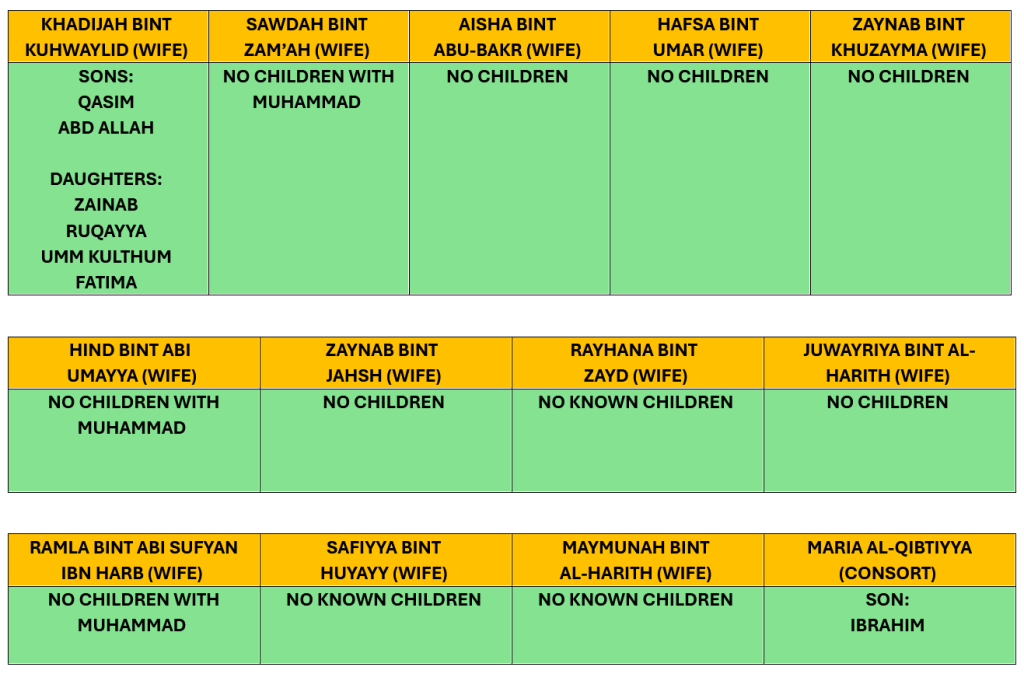
Khadija bint Khuwaylid (سلام الله علیها) was a wealthy widow and owner of a caravan. When she married Muhammad, she was forty years old, and he was twenty-five. Even though polygamy was a custom in their culture, Muhammad never took another wife during Khadija’s lifetime. She was Muhammad’s strongest supporter and the first convert to Islam.
During their 25-year marriage, Khadija bore Muhammad two sons and four daughters. Their sons died in early childhood.
THE REVELATION IN THE CAVE ON MOUNT HIRA
In the years following this marriage, Muhammad began to go into the hills surrounding Mecca to ponder the fate of his people. He was especially concerned about their idolatry, and the fate that would await them on judgement day. During these periods of meditation, he received visits from the archangel Gabriel. According to Islamic tradition, during the month of Ramadan, in a cave on Mount Hira, Gabriel brought the following command from God:
Recite! In the name of the Lord who created!
Who created man from a blood clot!
Recite! And the Lord is the Most Generous.
Who was taught by the pen-
Taught man what he knew not.
At frequent intervals throughout the rest of his life, Muhammad received revelations from God in this fashion. Muhammad memorized the contents of these divine messages and taught them to his companions. Eventually, they were committed to writing and became scripture contained in the Holy Quran.
Muslims believe that Muhammad is the last of the prophets, and that all the prophets who came before had only pieces of God’s message. It is believed that the final and complete message was revealed to Muhammad. Islam does not deny the validity of other religions, but rather sees itself as the completion of God’s covenant with His human creation.
Muhammad never considered himself to be anything other than a prophet and messenger. He never claimed to be divine. His mission was only to deliver God’s final message to the people.
When Muhammad first began to preach God’s message to the people of Mecca, he was not received well. Many were even openly hostile toward him. Many of them saw his preaching of the oneness of God and the sin of idolatry as a threat to their economic success. Many travelers from all over the world came to the Kaaba for pilgrimage and did a lot of business in Mecca.
Those closest to Muhammad were among the first converts to Islam. Aside from his wife, Khadija, there was also his cousin Ali, a former slave, Zayd, and his close friend, Abu Bakr. In the following years, more converts joined them. Most converts came from the poorer, enslaved, and younger people in their society. The fact that Islam began to preach that all people were equal before God appealed to a lot of people. Especially those who were underprivileged and treated as lesser. The reaction to this was that the elder and wealthier class of people who enjoyed their status and privileges aggressively opposed these ideas.
Muhammad continued his preaching regardless, and even though most of his own clan were not Muslims in the beginning, they still protected one of their own. If Muhammad was not from the Quraysh tribe, who was the most powerful tribe in Mecca, things most likely would have been even more dangerous and more difficult for Muhammad. Eventually, though, the opposition became more severe and violent, and Muhammad encouraged his followers to leave Mecca.
THE MIGRATION (HIJRAH)
In 615 C.E., about 15 Muslims fled Mecca and took refuge in the Christian Kingdom of Abyssinia (Ethiopia). Muhammad and the rest of his followers stayed behind and continued to preach in the face of prosecution.
In 619 C.E., Muhammad suffered the loss of his two greatest supporters. His powerful uncle and chief, Abu-Talib, and his beloved wife, Khadija. The death of Abu-Talib left him without the protection of his tribe, and life became extremely difficult for the Muslims in Mecca. After Khadijah’s death, Muhammad married Sawdah bint Zam’ah (سلام الله علیها). She was around 40 years old and a widow with six children.
One of the most significant events in the history of Islam was in 620 C.E. A group of six men journeyed from the city of Yathrib (Medina). They came to seek the wisdom of Muhammad, whom they had heard was an honest, just, and wise man. At the time, Yathrib was a city divided by clan warfare and internal strife. They needed an impartial person to judge their disputes, and this delegation of men believed that Muhammad could be that judge. Muhammad considered their offer, but made no final decision.
The following year, 12 more delegates from Yathrib appeared in Mecca to seek Muhammad’s counsel. Ten of these twelve men were from Jewish tribes. A few of the Jewish men thought that Muhammad could possibly be the Messiah. An invitation was extended to him to become the governor of their city again.
In 622 C.E., Muhammad and his followers had to sneak out of Mecca in order to avoid assassins who wanted to eliminate Muhammad. After the escape, Muhammad finally made it to Yathrib. The journey from Mecca to Yathrib is known as the hijrah (the migration). This is the moment from which Muslims date their calendar, and it was most likely around the time that they started to refer to this city as Medina.
In Medina, the Muslims took up residence beside the other tribes and clans. Muhammad may have been invited to govern and arbitrate between the tribes there, but the people there were of different religions. An agreement was made, known as the ‘Medina Charter.’ This agreement granted political authority to Muhammad, but gave freedom of religious practice to the members of other religious communities. Three of the tribes in Medina were Jewish, and most of the others were Christian and probably other religious groups.
In Mecca, Muhammad was dealing mainly with polytheists, but in Medina, he was met with strong resistance from Jewish monotheists. This began to create divisions between the Jews and Muslims. Around this time, Muhammad instructed Muslims that they would face Mecca to pray, when before they were praying toward Jerusalem. Regardless of this change, Jerusalem still remains the third-holiest city to Muslims after Mecca and Medina.
In 623 C.E. Muhammad married Aisha (سلام الله علیها). She was the daughter of his friend Abu Bakr. This marriage is the most controversial marriage of Muhammad, because Aisha was very young at the time. However, it was common for political marriage alliances between tribes. This marriage cemented a tribal alliance between the good friends by linking their clans. This does not imply that Muhammad and Aisha had a marital relationship at the moment of the marriage. There is no actual evidence of this.
Around this time, conflicts started to heat up between Medina and Mecca. The conflicts began as Muslims raiding caravans from Mecca, but intensified and widened into full-scale military campaigns. The Arabs at this time did not consider it dishonorable to raid caravans. Such raids allowed Muslims to seek revenge against Mecca, but also to acquire money and goods.
During the Battle of Badr in 624 C.E., the Muslims defeated Mecca. Muhammad’s presence during this battle rallied and encouraged his Muslim fighters, gave them strength, valor, fortitude, and determination. Their victory reinforced their loyalty to their prophet and even attracted others to Islam.
Conflict between the Muslims and Jewish tribes began to increase also. By now, the Jewish people had rejected any notion that Muhammad could possibly be the awaited Messiah. The same Jewish tribes that invited him to Medina even began to mock and ridicule him publicly. This was probably a reaction to Muhammad’s growing influence and more people converting to Islam. This mocking and humiliation was probably somewhat similar to what Jesus (ﷺ) experienced during his time. There were even times when some of the Jewish tribal leaders would support Mecca against the Muslims. Due to this treachery, the Jewish people were given a choice: either convert to Islam or leave the city.
In 625 C.E., Muhammad married Hafsa bint Umar (سلام الله علیها), a young widow. Hafsa was considered an intellectual and scholar. Marriage to Hafsa also solidified an alliance with her father’s tribe. In this same year, Muhammad also married Zaynab bint Khuzayma (سلام الله علیها), a divorcee, and Hind ‘Umm Salama’ bint Abi Umayya (سلام الله علیها), another widow with five children. These two marriages encouraged Muslim men not to be discouraged from marrying divorcees and widows. Marriage to Zaynab was also an important political match for Muhammad, and Umm Salama was the widow of Muhammad’s Bedouin milk-brother.
THE ATTEMPTED SIEGE OF MEDINA AND THE BATTLE OF KHAYBAR
In 627 C.E., 10,000 soldiers from Mecca attempted to lay siege to Medina, but had to retreat when they failed to take the city. Islamic historians consider this battle a great victory for Muhammad and a major turning point for the Muslims. This was also the year when Muhammad married Zaynab bint Jahsh (سلام الله علیها), his cousin. Initially, Muhammad tried to arrange a marriage between her and his foster son Zayd (who was his former slave), and Zaynab rejected this proposal at first, but after understanding the meaning behind it accepted.
For some reason, the marriage did not last. Zayd and Zaynab divorced. And then Muhammad married her. The initial arranged marriage between Zayd and Zaynab was to show the community that one’s class or social status, current or former, has no standing, as all were equal before God. Muhammad’s marriage to Zaynab after the divorce showed that a foster child still belongs to their own tribe and that they did not have the same cultural kinship as milk siblings and milk fosterlings did. (This custom will be explained in more depth in another publication.)
Also in 627 C.E., it is believed that Muhammad freed and married his Jewish captive, Rayhana bint Zayd (سلام الله علیها). The reason why it is believed that they married is that there was a mention of Muhammad paying Mahr upon marriage to her. Mahr is a bride’s gift. It is much like a dowry, gifted to the bride by her Muslim husband upon their marriage.
In 628 C.E., Muhammad made two more marriages. He married two widows, Juwayriya bint al-Harith (سلام الله علیها) and Ramla bint Abi Sufyan ibn Har (سلام الله علیها). These two marriages were also strategic tribal alliances. Juwayriya was a member of the Banu Mustaliq tribe. Ramla’s father was a member of the Umayya Clan and chief of the Quraysh tribe. At the time, Ramla’s father was Muhammad’s most formidable adversary and opponent. Eventually, Ramla’s father converted to Islam and joined with Muhammad. In this year, Muhammad attempted to enter Mecca on pilgrimage with his Muslim followers, but they were prevented from entering the city.
628 was also the year of the Battle of Khaybar. During this battle, the Jewish people of Khaybar (who had betrayed Muhammad and were exiled from Medina previously), faced off with the Muslims, which resulted in a Jewish defeat. In this battle, Safiyya bint Huyayy (سلام الله علیها) was widowed and captured. Muhammad decided to marry Safiyya. Aside from accounts of her exceptional beauty, she was an important, prominent, and influential person in her tribe. In this year, Muhammad also married twice widowed, Maymunah bint al-Harith (سلام الله علیها). Her father was a member of the Hilali tribe.
Another woman who joined Muhammad’s household was Maria al-Qibtiyya (سلام الله علیها). She and her sister were Coptic Christian slaves from Egypt and were gifted to Muhammad. Muhammad gave the sister to his good friend, Hassan ibn Thabit, and kept Maria for his own household. Muslim scholars do not believe that Muhammad ever married Maria, but there is a record that she was freed after she gave Muhammad a son and that she was given the same courtesy title, “Mothers of the Believers,’ just as his wives were.
THE HAJJ (THE PILGRIMAGE)
By 629 C.E., Islam had grown so strong that a peace agreement was negotiated between Mecca and the Muslims of Medina. No one could prevent them from entering the city for pilgrimage this time.
In 630 C.E., Muhammad and an army of 10,000 Muslims came to conquer Mecca. After their victory, Muhammad went straight to the Kaaba and destroyed all the idols and images within it. Afterwards, Muhammad was viewed as the leader of the Arabian people.
During the next few years, Islam continued to grow. Disciples were sent to deliver the Quran and spread the Word of God to the Bedouin of the Arabian desert and the surrounding nations. In 632 C.E., Muhammad led the Muslims on another pilgrimage to Mecca. By this time, he was 62 years old and in declining health. Upon his return to Medina, he delivered his final farewell message to the Muslim people and died in the arms of his wife, Aisha. The following words were spoken at his funeral by his good friend and father-in-law, Abu Bakr:
O ye people,
If anyone worships Muhammad,
Muhammad is dead!
But if anyone worships God,
He is alive and dies not!
There had been no arrangements regarding Muhammad’s successor.


 Vault of Stones