‘Indeed, it is We who sent down the Qur’an and indeed, We will be its guardian.’ -Quran ‘Al-Hijir’ Verse 9
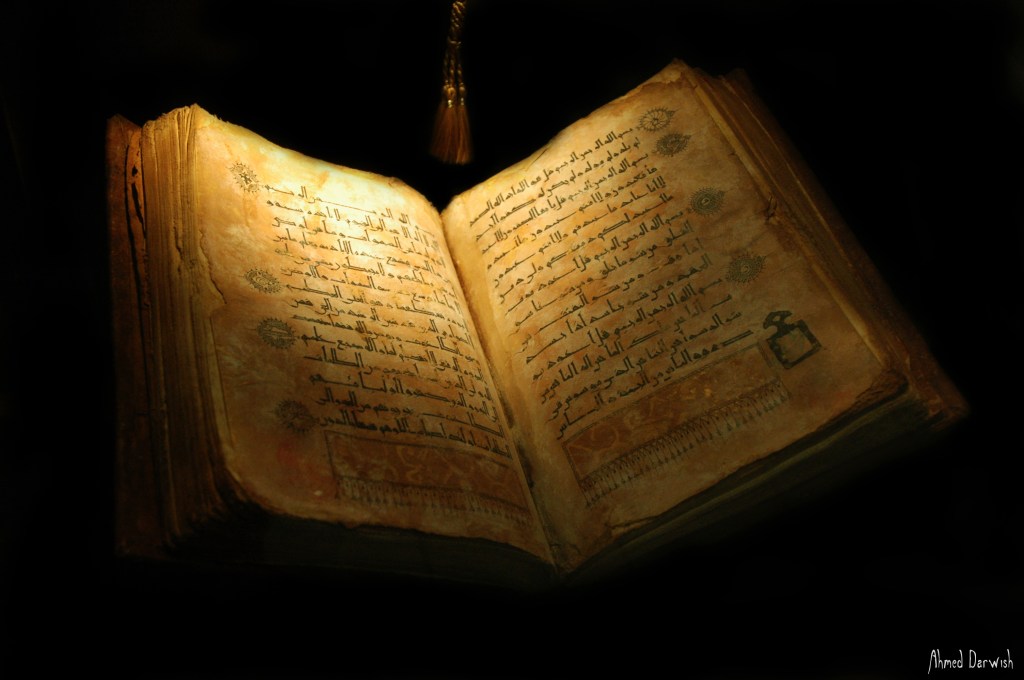
The scripture is Islam is called the ‘Quran.’ The word Quran means both ‘reading’ and ‘recitation.’ Muslims believe that the Quran is a recitation of an eternal scripture, written in heaven and revealed, chapter by chapter, to the Prophet Muhammad (ﷺ). The title of the scripture also relates to the first Surah (chapter), which is ‘Recite in the name of thy Lord who created…’
It can be argued that no scripture in the history of the world has been so influential to its people. Surely no scripture has been read as much or committed to memory as often. Although Jewish and Christian people revere their scripture, human, though inspired, authorship is acknowledged. Such is not the case with the Quran. The Quran is the direct word of God. It is eternal, absolute, and irrevocable. The Quran is believed to be God’s last word to humanity. Islam respects the Jewish and Christian scriptures, but the Quran is understood as God’s final message.
The Quran was revealed to Muhammad verbally, as he committed it to memory. Ever since it has remained unaltered and unchanged. The Quran of today is the exact same Quran at the time of the Prophet Muhammad. This is the miracle of the Quran itself, as God promised that it would be protected from corruption.
Recitation of the Quran is an important ritual and the source of God’s blessing because it produces his divine speech. Customarily, the first thing a Muslim infants hear when they are born is verses from the Quran. These verses are often gently chanted in their ears. Beautiful calligraphy verse from the Quran adorns the walls of the homes of Muslims. And its verses are often the last thing Muslims hear before death.
Among Muslims, it is considered a supreme act of piety and devotion to commit the entire Quran to memory. Those who achieve this extraordinary feat are given the honorary title of ‘Hafiz.’
The Quran is considered the exact words of God. The revelations that make up the Quran are organized into 114 chapters called ‘Surahs.’ The Surahs contain about 6,000 verses, called ‘Ayats.’ There is no topical or chronological order to the Quran. They are arranged based on the length of the Surah in descending order. The longest Surah contains 287 Ayats, and the shortest only contains 3.
Clicking on the Quran button below will take you to an online Quran hosted on quran.com
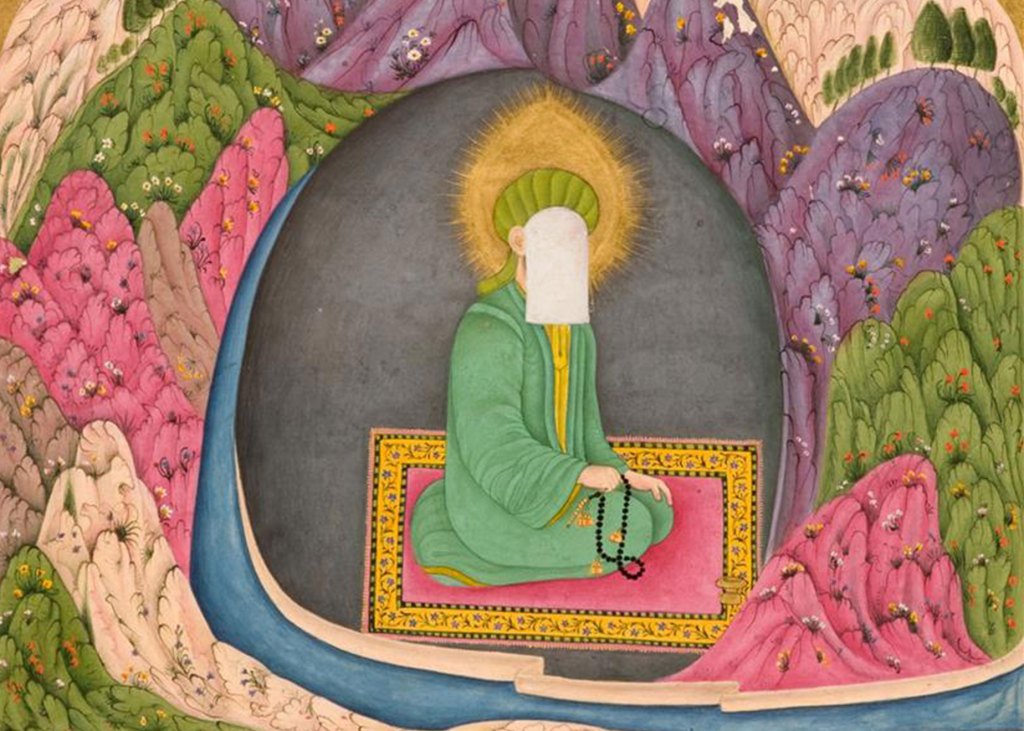
1720 painting of the Prophet Muhammad, titled ‘Prophet Muhammad in the Cave of Hira.’ Paintings and images of any of the prophets is taboo to most Muslims. However, there was a time when Persian, Ottoman, and Mughal artists would paint the Prophet in miniature for personal manuscripts, though a veil was usually used to hide his face.
Born: Around 570 C.E. (Mecca)] Died: 632 (Medina) Father: Abdullah Ibn Abd Al-Muttalib Mother: Amina Bint Wahb Milk Mother: Halimah bint Abi Dhuayb Siblings: None Milk Siblings: 2 milk-brothers, Abd Allah Ibn Al-Harith, Abdullah Al-Harith. 2 milk-sisters, Hothafa Bint Al-Harith, Anissa Bint Al-Harith
Because Islam is one of the youngest of the world’s religions, the details of the life and the founder are more readily available than those of other founders. No one can question that Muhammad (ﷺ) was a historical figure and lived in the 7th century C.E.
Muhammad was born into the clan of Al-Hashim of the Quraysh tribe. The Quraysh tribe controlled the Kaaba in Mecca. Muhammad was orphaned at a very young age. His father died of an illness while his mother was pregnant with him. When Muhammad was an infant, his mother sent him into the desert to be fostered by a Bedouin tribe. This was a custom of the time. Having a milk mother was a sacred tradition. It was believed that growing up in the desert as a semi-nomad was very important for character development. Muhammad was fostered by his milk-mother until he was six years old. Afterwards, he returned to his mother and his own tribe. After he returned, Muhammad went with his mother to visit her family in Yathrib. Shortly after this, Muhammad’s mother died of an illness, leaving Muhammad a young orphan.
After losing both parents, Muhammad joined the household of his uncle, Abu-Talib, who was the chief of the Quraysh tribe. Life for an orphan in the 7th century was difficult. Muhammad was not able to obtain a formal education, and it was noted that Muhammad may have been illiterate or barely literate. This is why Muslims consider the revelation of the Quran to him all the more miraculous. He was not some kind of skilled literary poet, yet suddenly, poetic words started flowing from him.
In the 6th century C.E., the merchants of Mecca controlled the trading caravans that moved between the Indian Ocean and the Mediterranean Sea. This, along with the Kaaba, brought great wealth to Mecca. Muhammad worked and traveled with the caravans. During his travels, he would have come into contact with people from many different cultures and religions. It is assumed he met plenty of Christians, Jews, and Zoroastrians during his travels. Something these three religions had in common was that all believed in one God; and they all had scripture that they believed to be the word of God; and they all believed that the world would end one day, the righteous would be rewarded, and the evil would be punished.
Years as a caravaner most likely taught Muhammad mathematical and business skills. He earned the reputation of being honest, faithful, loyal, and trustworthy. This is probably what afforded Muhammad the opportunity to meet the woman who would become his first wife.
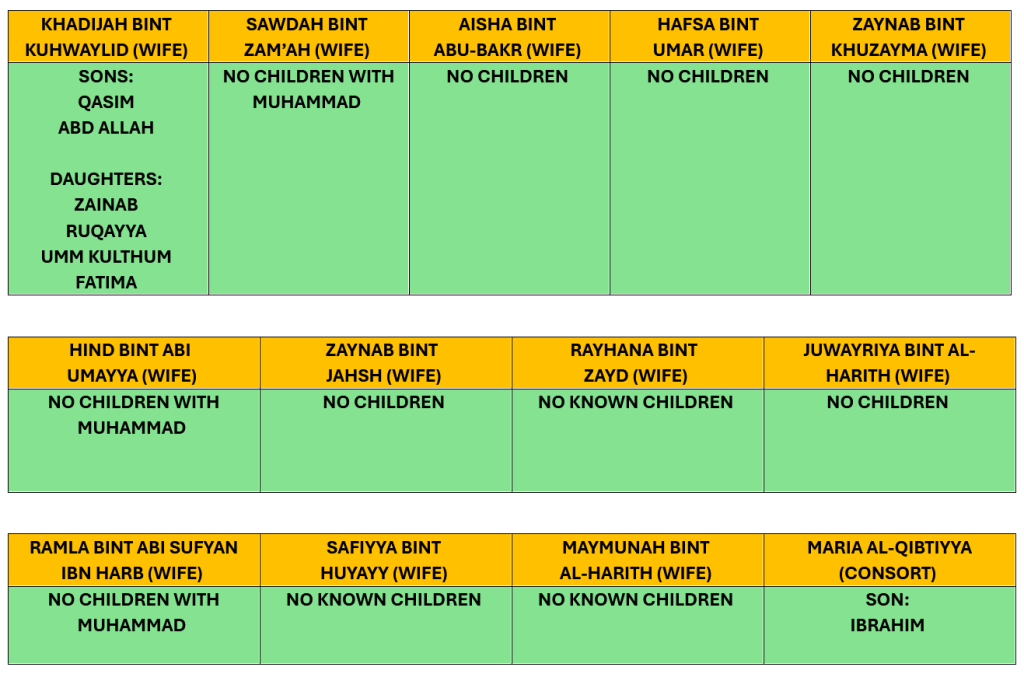
Khadija bint Khuwaylid (سلام الله علیها) was a wealthy widow and owner of a caravan. When she married Muhammad, she was forty years old, and he was twenty-five. Even though polygamy was a custom in their culture, Muhammad never took another wife during Khadija’s lifetime. She was Muhammad’s strongest supporter and the first convert to Islam.
During their 25-year marriage, Khadija bore Muhammad two sons and four daughters. Their sons died in early childhood.
THE REVELATION IN THE CAVE ON MOUNT HIRA
In the years following this marriage, Muhammad began to go into the hills surrounding Mecca to ponder the fate of his people. He was especially concerned about their idolatry, and the fate that would await them on judgement day. During these periods of meditation, he received visits from the archangel Gabriel. According to Islamic tradition, during the month of Ramadan, in a cave on Mount Hira, Gabriel brought the following command from God:
Recite! In the name of the Lord who created! Who created man from a blood clot! Recite! And the Lord is the Most Generous. Who was taught by the pen- Taught man what he knew not.
At frequent intervals throughout the rest of his life, Muhammad received revelations from God in this fashion. Muhammad memorized the contents of these divine messages and taught them to his companions. Eventually, they were committed to writing and became scripture contained in the Holy Quran.
Muslims believe that Muhammad is the last of the prophets, and that all the prophets who came before had only pieces of God’s message. It is believed that the final and complete message was revealed to Muhammad. Islam does not deny the validity of other religions, but rather sees itself as the completion of God’s covenant with His human creation.
Muhammad never considered himself to be anything other than a prophet and messenger. He never claimed to be divine. His mission was only to deliver God’s final message to the people.
When Muhammad first began to preach God’s message to the people of Mecca, he was not received well. Many were even openly hostile toward him. Many of them saw his preaching of the oneness of God and the sin of idolatry as a threat to their economic success. Many travelers from all over the world came to the Kaaba for pilgrimage and did a lot of business in Mecca.
Those closest to Muhammad were among the first converts to Islam. Aside from his wife, Khadija, there was also his cousin Ali, a former slave, Zayd, and his close friend, Abu Bakr. In the following years, more converts joined them. Most converts came from the poorer, enslaved, and younger people in their society. The fact that Islam began to preach that all people were equal before God appealed to a lot of people. Especially those who were underprivileged and treated as lesser. The reaction to this was that the elder and wealthier class of people who enjoyed their status and privileges aggressively opposed these ideas.
Muhammad continued his preaching regardless, and even though most of his own clan were not Muslims in the beginning, they still protected one of their own. If Muhammad was not from the Quraysh tribe, who was the most powerful tribe in Mecca, things most likely would have been even more dangerous and more difficult for Muhammad. Eventually, though, the opposition became more severe and violent, and Muhammad encouraged his followers to leave Mecca.
THE MIGRATION (HIJRAH)
In 615 C.E., about 15 Muslims fled Mecca and took refuge in the Christian Kingdom of Abyssinia (Ethiopia). Muhammad and the rest of his followers stayed behind and continued to preach in the face of prosecution.
In 619 C.E., Muhammad suffered the loss of his two greatest supporters. His powerful uncle and chief, Abu-Talib, and his beloved wife, Khadija. The death of Abu-Talib left him without the protection of his tribe, and life became extremely difficult for the Muslims in Mecca. After Khadijah’s death, Muhammad married Sawdah bint Zam’ah (سلام الله علیها). She was around 40 years old and a widow with six children.
One of the most significant events in the history of Islam was in 620 C.E. A group of six men journeyed from the city of Yathrib (Medina). They came to seek the wisdom of Muhammad, whom they had heard was an honest, just, and wise man. At the time, Yathrib was a city divided by clan warfare and internal strife. They needed an impartial person to judge their disputes, and this delegation of men believed that Muhammad could be that judge. Muhammad considered their offer, but made no final decision.
The following year, 12 more delegates from Yathrib appeared in Mecca to seek Muhammad’s counsel. Ten of these twelve men were from Jewish tribes. A few of the Jewish men thought that Muhammad could possibly be the Messiah. An invitation was extended to him to become the governor of their city again.
In 622 C.E., Muhammad and his followers had to sneak out of Mecca in order to avoid assassins who wanted to eliminate Muhammad. After the escape, Muhammad finally made it to Yathrib. The journey from Mecca to Yathrib is known as the hijrah (the migration). This is the moment from which Muslims date their calendar, and it was most likely around the time that they started to refer to this city as Medina.
In Medina, the Muslims took up residence beside the other tribes and clans. Muhammad may have been invited to govern and arbitrate between the tribes there, but the people there were of different religions. An agreement was made, known as the ‘Medina Charter.’ This agreement granted political authority to Muhammad, but gave freedom of religious practice to the members of other religious communities. Three of the tribes in Medina were Jewish, and most of the others were Christian and probably other religious groups.
In Mecca, Muhammad was dealing mainly with polytheists, but in Medina, he was met with strong resistance from Jewish monotheists. This began to create divisions between the Jews and Muslims. Around this time, Muhammad instructed Muslims that they would face Mecca to pray, when before they were praying toward Jerusalem. Regardless of this change, Jerusalem still remains the third-holiest city to Muslims after Mecca and Medina.
In 623 C.E. Muhammad married Aisha (سلام الله علیها). She was the daughter of his friend Abu Bakr. This marriage is the most controversial marriage of Muhammad, because Aisha was very young at the time. However, it was common for political marriage alliances between tribes. This marriage cemented a tribal alliance between the good friends by linking their clans. This does not imply that Muhammad and Aisha had a marital relationship at the moment of the marriage. There is no actual evidence of this.
Around this time, conflicts started to heat up between Medina and Mecca. The conflicts began as Muslims raiding caravans from Mecca, but intensified and widened into full-scale military campaigns. The Arabs at this time did not consider it dishonorable to raid caravans. Such raids allowed Muslims to seek revenge against Mecca, but also to acquire money and goods.
During the Battle of Badr in 624 C.E., the Muslims defeated Mecca. Muhammad’s presence during this battle rallied and encouraged his Muslim fighters, gave them strength, valor, fortitude, and determination. Their victory reinforced their loyalty to their prophet and even attracted others to Islam.
Conflict between the Muslims and Jewish tribes began to increase also. By now, the Jewish people had rejected any notion that Muhammad could possibly be the awaited Messiah. The same Jewish tribes that invited him to Medina even began to mock and ridicule him publicly. This was probably a reaction to Muhammad’s growing influence and more people converting to Islam. This mocking and humiliation was probably somewhat similar to what Jesus (ﷺ) experienced during his time. There were even times when some of the Jewish tribal leaders would support Mecca against the Muslims. Due to this treachery, the Jewish people were given a choice: either convert to Islam or leave the city.
In 625 C.E., Muhammad married Hafsa bint Umar (سلام الله علیها), a young widow. Hafsa was considered an intellectual and scholar. Marriage to Hafsa also solidified an alliance with her father’s tribe. In this same year, Muhammad also married Zaynab bint Khuzayma (سلام الله علیها), a divorcee, and Hind ‘Umm Salama’ bint Abi Umayya (سلام الله علیها), another widow with five children. These two marriages encouraged Muslim men not to be discouraged from marrying divorcees and widows. Marriage to Zaynab was also an important political match for Muhammad, and Umm Salama was the widow of Muhammad’s Bedouin milk-brother.
THE ATTEMPTED SIEGE OF MEDINA AND THE BATTLE OF KHAYBAR
In 627 C.E., 10,000 soldiers from Mecca attempted to lay siege to Medina, but had to retreat when they failed to take the city. Islamic historians consider this battle a great victory for Muhammad and a major turning point for the Muslims. This was also the year when Muhammad married Zaynab bint Jahsh (سلام الله علیها), his cousin. Initially, Muhammad tried to arrange a marriage between her and his foster son Zayd (who was his former slave), and Zaynab rejected this proposal at first, but after understanding the meaning behind it accepted.
For some reason, the marriage did not last. Zayd and Zaynab divorced. And then Muhammad married her. The initial arranged marriage between Zayd and Zaynab was to show the community that one’s class or social status, current or former, has no standing, as all were equal before God. Muhammad’s marriage to Zaynab after the divorce showed that a foster child still belongs to their own tribe and that they did not have the same cultural kinship as milk siblings and milk fosterlings did. (This custom will be explained in more depth in another publication.)
Also in 627 C.E., it is believed that Muhammad freed and married his Jewish captive, Rayhana bint Zayd (سلام الله علیها). The reason why it is believed that they married is that there was a mention of Muhammad paying Mahr upon marriage to her. Mahr is a bride’s gift. It is much like a dowry, gifted to the bride by her Muslim husband upon their marriage.
In 628 C.E., Muhammad made two more marriages. He married two widows, Juwayriya bint al-Harith (سلام الله علیها) and Ramla bint Abi Sufyan ibn Har (سلام الله علیها). These two marriages were also strategic tribal alliances. Juwayriya was a member of the Banu Mustaliq tribe. Ramla’s father was a member of the Umayya Clan and chief of the Quraysh tribe. At the time, Ramla’s father was Muhammad’s most formidable adversary and opponent. Eventually, Ramla’s father converted to Islam and joined with Muhammad. In this year, Muhammad attempted to enter Mecca on pilgrimage with his Muslim followers, but they were prevented from entering the city.
628 was also the year of the Battle of Khaybar. During this battle, the Jewish people of Khaybar (who had betrayed Muhammad and were exiled from Medina previously), faced off with the Muslims, which resulted in a Jewish defeat. In this battle, Safiyya bint Huyayy (سلام الله علیها) was widowed and captured. Muhammad decided to marry Safiyya. Aside from accounts of her exceptional beauty, she was an important, prominent, and influential person in her tribe. In this year, Muhammad also married twice widowed, Maymunah bint al-Harith (سلام الله علیها). Her father was a member of the Hilali tribe.
Another woman who joined Muhammad’s household was Maria al-Qibtiyya (سلام الله علیها). She and her sister were Coptic Christian slaves from Egypt and were gifted to Muhammad. Muhammad gave the sister to his good friend, Hassan ibn Thabit, and kept Maria for his own household. Muslim scholars do not believe that Muhammad ever married Maria, but there is a record that she was freed after she gave Muhammad a son and that she was given the same courtesy title, “Mothers of the Believers,’ just as his wives were.
THE HAJJ (THE PILGRIMAGE)
By 629 C.E., Islam had grown so strong that a peace agreement was negotiated between Mecca and the Muslims of Medina. No one could prevent them from entering the city for pilgrimage this time.
In 630 C.E., Muhammad and an army of 10,000 Muslims came to conquer Mecca. After their victory, Muhammad went straight to the Kaaba and destroyed all the idols and images within it. Afterwards, Muhammad was viewed as the leader of the Arabian people.
During the next few years, Islam continued to grow. Disciples were sent to deliver the Quran and spread the Word of God to the Bedouin of the Arabian desert and the surrounding nations. In 632 C.E., Muhammad led the Muslims on another pilgrimage to Mecca. By this time, he was 62 years old and in declining health. Upon his return to Medina, he delivered his final farewell message to the Muslim people and died in the arms of his wife, Aisha. The following words were spoken at his funeral by his good friend and father-in-law, Abu Bakr:
O ye people, If anyone worships Muhammad, Muhammad is dead! But if anyone worships God, He is alive and dies not!
There had been no arrangements regarding Muhammad’s successor.
Islam began among the desert Arabian people in the 7th century C.E. It did not spring out of a religious vacuum. The people in this region followed and were exposed to various religions. Christianity had been very familiar to the the people. Judea, the home of Christianity was not far from Arabia. Damascus, Caesarea, Antioch, and Alexandria were neighbors to Mecca and Yathrib (Medina).
The people of Arabia would have also been familiar with Judaism. Several desert tribes were Jewish. Although the origins of these tribes are unclear, many historians believe that they were the descendants of Jewish people exiled from Judea by the Romans in 70 C.E. and 135 C.E. When the Prophet Muhammad (ﷺ) entered Medina in 622 C.E. many of the residents of the city were Jewish.
Another religion that was prominent at the time in the region was Zoroastrianism. It is possible that Muhammad and some of his disciples engaged with Persian Zoroastrians.
Perhaps the major religious force from which Islam emerged and/or reacted against was the native religion of the Arab people. We know very little about the religions of the Arabs before Islam, as the only record and accounts come from Muslim sources. These are naturally going to be critical of the religions that were replaced.
It was documented that the pre-Islamic people (who were not Jewish or Christian) worshiped a variety of gods, though they recognized one supreme creator deity. who was separate and unapproachable by human beings. They called this deity ‘Allah,’ which translated to ‘The God.’ However, the deities that received the most attention and worship were the local tribal gods. Images of these gods were carved and cherished. Blood sacrifices were made to them. In addition to a great pantheon of the gods of heaven and earth, there were lesser divine creatures. Supernatural beings like angels and faeries were believed to be helpful, and demonic creatures were feared and believed to be harmful.
The most obvious characteristic of some of these religions was they were animistic. The people believed they found gods and supernatural beings in stones, trees, wells, and animals. The city of Mecca became a hub of cultural exchange, especially of animistic ideologies. It was also a trading/caravan depot, where people came to sell and exchange goods from distant lands.
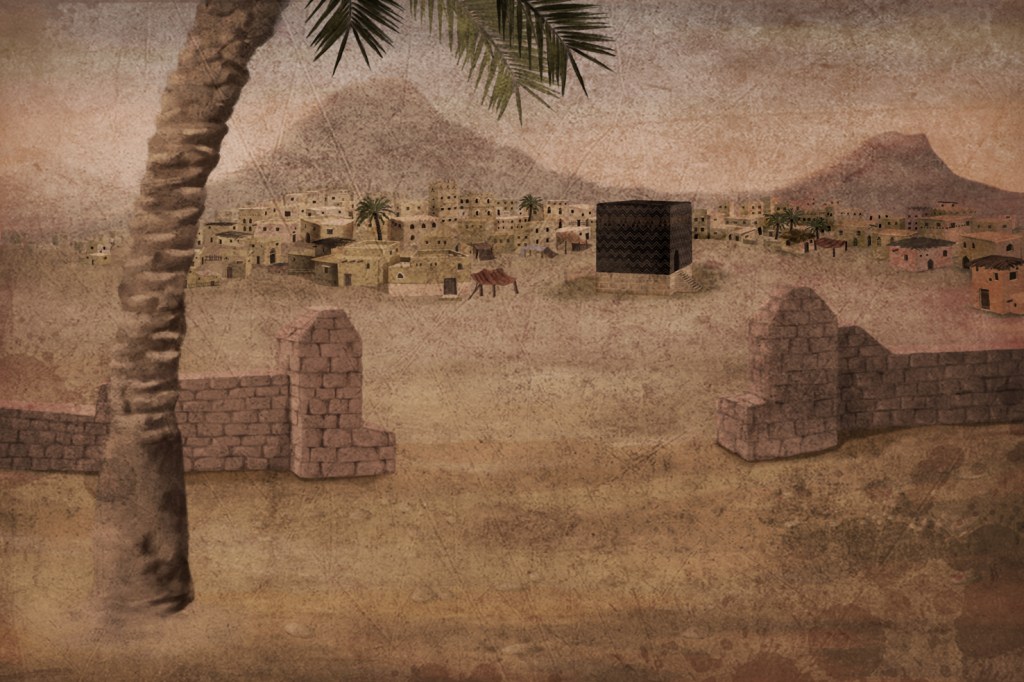
Mecca is located on the central-western coast of Arabia, and in those earlier times, is was along the north and south caravan route. It became famous for the mysterious meteoroic stone than had fallen there centuries before. The stone was an object of veneration to the animistic population. By the time of Muhammad (ﷺ), there was already an enclosure built around this stone. This enclosure was called the Kaaba. Eventually the Kaaba was filled with many relics and icons and other objects revered by the people who traveled there as pilgrims and with trade caravans.
(There is a legend which surrounds the black stone and the Kaaba that houses it. A legend about the prophet Abraham (ﷺ) and his son Ishmael. See: Legend of Al-Hajaru Al-Aswad and The Story of the Kaaba.)
The story of the Kaaba is a story about the Prophet Arbraham (ﷺ) and his eldest son, Ishmael (ﷺ).
THE GREAT TEST OF FAITH
The Prophet Abraham (ﷺ), known for his steadfast devotion to Allah and his unwavering commitment to righteousness, found his faith tested in ways unimaginable. His journey began with a vision, a divine revelation from Allah instructing him to sacrifice his beloved son, Ishmael (ﷺ), as a test of his devotion.
Though shaken to his core by the weight of this divine command, Abraham did not hesitate to heed the call of his Lord. With a heavy heart and tears streaming down his face, he approached Ishmael and shared with him the solemn news, preparing to fulfill Allah’s will with unwavering obedience.
Ishmael, ever the epitome of faith and submission, accepted his father’s decision with grace and humility, understanding that it was Allah’s decree and that their sacrifice was an act of devotion beyond measure. Together, father and son embarked on a journey to fulfill Allah’s command, their hearts united in faith and surrender to the divine will.
When they reached the appointed spot, a desolate hill overlooking the sacred city of Mecca. With trembling hands and steadfast hearts, Abraham prepared to carry out the sacrifice, his love for Ishmael mingling with his unwavering devotion to Allah. Just as Abraham raised his hand to fulfill the divine command, Allah intervened with a miraculous decree. In place of Ishmael, a ram appeared, its horns caught in a thicket, offering itself as a substitute for the sacrifice.
In that moment, Abraham and Ishmael were overcome with gratitude and relief, their faith affirmed and their bond strengthened by the mercy of Allah. They offered thanks to their Lord for His divine intervention, acknowledging that He alone is the source of all mercy and compassion.
THE WELL OF ZAMZAM
As the sands of time shifted and the pages of history turned, another chapter unfolded in the lives of Prophet Abraham (ﷺ) and his beloved son Ishmael (ﷺ).
After Ishmael’s miraculous rescue from the intended sacrifice, Abraham faced another moment of trial and tribulation. As commanded by Allah, he made the difficult decision to send Ishmael and his mother, Hagar (سلام الله علیها), into the barren desert wilderness surrounding the sacred city of Mecca. Abraham entrusted Ishmael and Hagar to the care of Allah, knowing that their journey into the unknown was guided by divine providence. With faith as their compass and hope as their sustenance, mother and son set forth into the desert, their footsteps echoing across the vast expanse of sand and stone.
Days turned into nights, and the relentless sun beat down upon them with unyielding intensity. Thirst parched their throats, and hunger gnawed at their bellies as they wandered through the unforgiving terrain. Yet, in the depths of their despair, they clung to the promise of Allah’s mercy, trusting that He would not abandon them in their time of need.
And then, in a moment of divine intervention, Allah revealed His boundless grace to Hagar and Ishmael. As Ishmael lay crying out of thirst, Hagar desperately searched for water, running between the hills of Safa and Marwa in search of relief. It was then that Allah, in His infinite wisdom, performed a miracle that would echo through the ages.
From beneath the earth, a spring of fresh, cool water gushed forth, quenching Ishmael’s thirst and bringing newfound hope to Hagar’s heart. It was a miraculous well, known as Zamzam, whose waters would flow for generations to come, providing sustenance and solace to pilgrims from all corners of the earth.
With gratitude overflowing in their hearts, Hagar and Ishmael drank deeply from the blessed waters of Zamzam, their spirits renewed and their faith reaffirmed. They knew that Allah had heard their prayers and answered them in ways beyond their wildest imagination, guiding them through the wilderness with His divine providence.
THE BUILDING OF THE KAABA
After the miraculous revelation of Zamzam, Hagar (سلام الله علیها) and Ishmael (ﷺ) thrived in the desert, their lives sustained by the abundant blessings bestowed upon them by Allah. As Ishmael grew into a man of strength and wisdom, his faith remained steadfast, rooted in the teachings of his father, Prophet Abraham (ﷺ).
Meanwhile, Abraham, guided by Allah’s wisdom and divine providence, embarked on a journey of his own. Years passed, and his heart yearned to reunite with Ishmael, to see the son he had once feared lost to the sands of the desert. And so, heeding the call of his Lord, Abraham set forth once more, his footsteps guided by faith and hope.
Upon his return to the desert of Mecca, Abraham was greeted with joyous embraces and tears of gratitude by Ishmael and Hagar. Together, they rejoiced in the countless blessings bestowed upon them by Allah, their hearts overflowing with love and gratitude for His boundless mercy.
But their reunion was not merely a moment of celebration; it was also a divine calling to fulfill the sacred purpose ordained by Allah. With Abraham’s guidance, Ishmael and Hagar embarked on the monumental task of constructing the Kaaba, the sacred House of Allah destined to become the focal point of pilgrimage for generations to come.
Guided by the vision of Prophet Abraham and inspired by the divine guidance of Allah, Ishmael and Hagar labored tirelessly to build the Kaaba from the stones and sands of the desert. With each stone laid and each pillar raised, they felt the presence of Allah guiding their hands, infusing their creation with divine grace and purpose.
As they constructed the Kaaba, they incorporated the Black Stone into one of its corners. The stone, which was originally much larger, over time, was broken into several pieces. One of these pieces marked the post where they were Allah wanted them to build the Kaaba. They laid the foundations of the Kaaba first, positioning the Black Stone in its designated corner, and then proceeded to build the walls and roof of the structure around it.
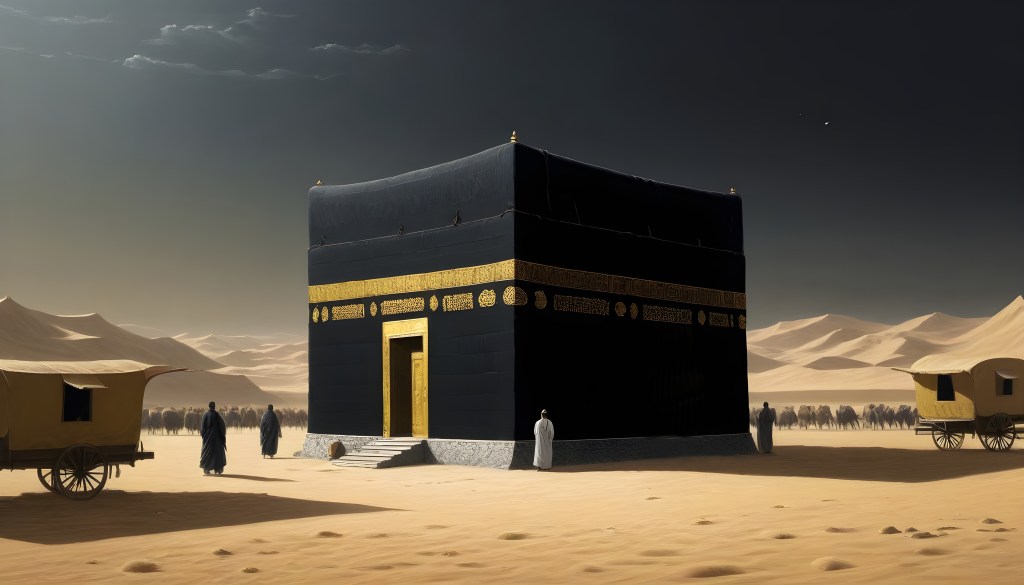
And so, amidst the barren expanse of the desert, the Kaaba rose majestically, a testament to the unwavering faith and devotion of Prophet Abraham, Ishmael, and Hagar. Its sacred walls echoed with the prayers of believers from every corner of the earth, drawing pilgrims to its hallowed sanctuary year after year.
The story of Prophet Abraham, Ishmael, and the Kaaba serves as a timeless reminder of the power of faith, perseverance, and divine providence. Theirs is a legacy that continues to inspire believers to this day, beckoning them to journey to the sacred sanctuary of the Kaaba and seek solace in the presence of Allah, the Most Merciful and Compassionate.
*The Kaaba, the sacred house of worship located in the center of the Grand Mosque in Mecca, is considered by Muslims to be the holiest site on Earth. According to Islamic tradition, the Kaaba was built by Prophet Abraham (Ibrahim) and his son Ishmael (Ismail) under the guidance of Allah. The construction of the Kaaba is intimately linked to the story of the White Meteorite that fell from the sky to mark the spot where Prophet Abraham and Ishmael were instructed to build their altar.
Islamic tradition holds that the Black Stone (Al-Hajar Al-Aswad), a cornerstone of the Kaaba, is the same White Meteorite that descended from the heavens. It is believed to have been a pristine, pure white stone when it first fell to Earth, marking the sacred site chosen by Allah for the construction of the Kaaba. If you would like to read about the legend of the black stone in the Kaaba, click here: The Legend of Al-Hajaru Al-Aswad
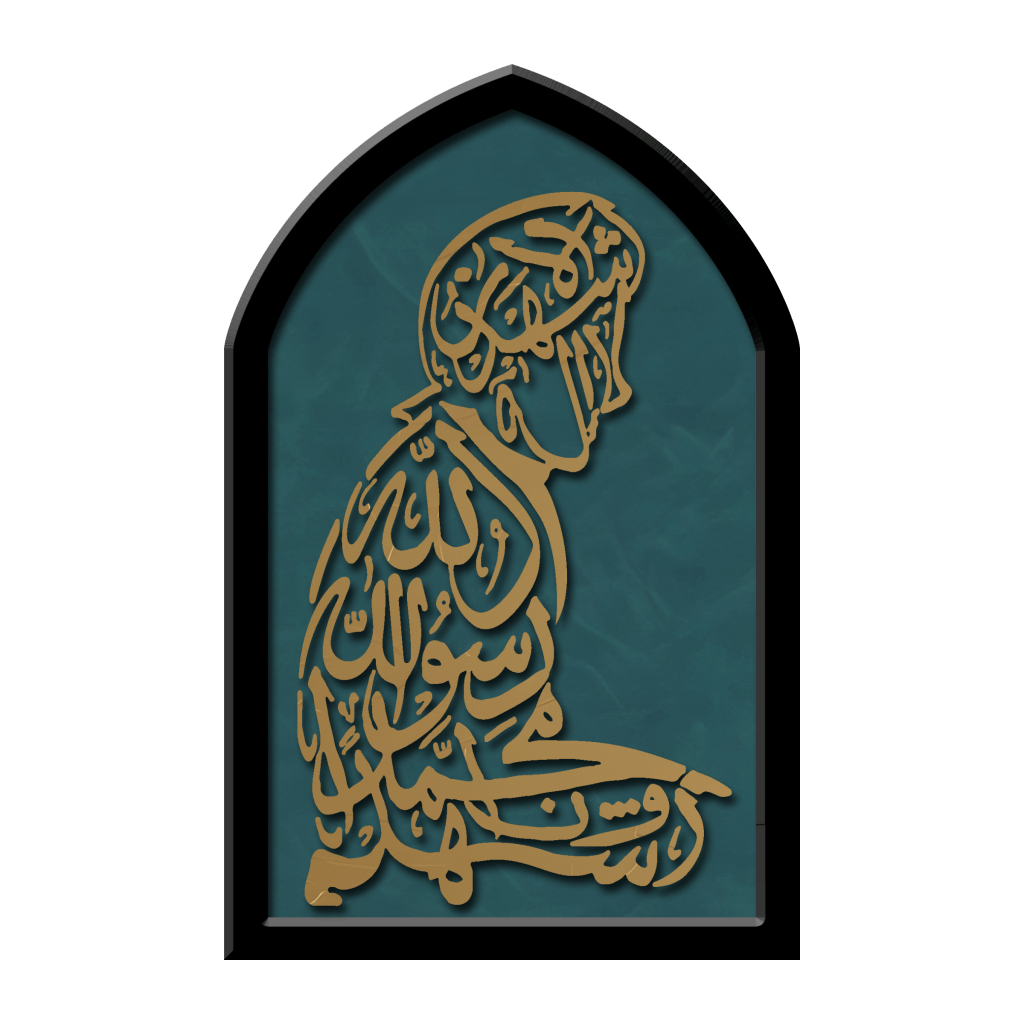
‘There is no deity aside from Allah and Muhammad is the messenger of Allah.’ -The Shahada
One of the youngest of the world’s major religions is Islam. It is also one of the largest, with almost two billion adherents. This is about 24% of the world’s population. There are around 50 countries in the world whose populations are mostly Muslim. Islam is the dominant religion in Asia and Africa.
The basis of Islamic belief is strict monotheism. There is only one God – one deity – who is the creator of all the seen and unseen. God is also transcendent, all knowing and everywhere at all times (omnipresent), all powerful and unrestricted (omnipotent), immortal, merciful, and just. In Islam, God is also conceived as panentheistic, meaning God’s omnipresence transcends space and time.
Muslims believe that even though Allah (God) was known by other Jewish and Christian prophets, and is worshiped by them too, his final revelation was to the Prophet Muhammad (ﷺ). Islam teaches that a person has just one life to live. How believers live this life determines how they will spend their eternal existence. During this life, believers must submit to the will of Allah. Thus, adherents of this religion are called ‘Muslims’ (those who submit to God).
*This page is still under construction. In time, links will be added below. Keep checking back to see if any new publications have been linked.*
Born: Undocumented Father: Azwar Al-Asadi Mother: Undocumented Siblings: 1 Known Brother, Dhiraar Ibn Al-Azwar. Spouse: Not documented Children: Not documented Died: 639 in Bilad Al-Sham (Syria)
Khawlah bint al-Azwar was a prominent figure in early Islamic history, known for her bravery, leadership, and contributions to the Muslim community. She was born in the 7th century in what is now Jordan. Khawlah gained fame during the lifetime of the Prophet Muhammad (ﷺ) and later during the Arab expansion. She is memorialized as one of the first female ghazis in Islamic history and is considered one of the most skilled female warriors in the history of the world.
Khawlah’s brother, Dhiraar, was a skilled warrior, and he taught his sister combat skills such as spear and sword fighting, as well as martial arts. Khawlah and her family are among the first families to convert to Islam in Mecca. She and her brother were companions of Prophet Muhammad (ﷺ), and fought in many battles together.
One of the most famous incidents involving Khawlah occurred during the Battle of Ajnadayn, where her brother was captured by Byzantine forces. In an act of courage and determination, Khawlah donned armor and led a rescue mission, displaying exceptional combat skills and rallying the Muslim troops to victory. One of the Rashidun army commanders, Shurahbil ibn Hassana, is reported to have said about her that: ‘This warrior fights like Khalid ibn Walid, but I am sure he is not Khalid.’ This was when many warriors thought she was Khalid Ibn Walid, until he showed up while Khawlah was engaged in combat. During this period, Muslim warriors wrapped themselves in loose riding robes and Bedouin-style keffiyehs. No one knew her identity until after the battle.
Khawlah’s unwavering commitment to Islam and her fearless spirit made her an inspiration for generations to come. She remains a symbol of female empowerment and resilience in Islamic history, celebrated for her bravery and contributions to the early Muslim community.


 Vault of Stones