The status of women in pre-Islamic Arabia was significantly low. Practices such as female infanticide were reportedly common to limit the female population. Women were often regarded as property, controlled by their father, husband, or elder brother. A husband could divorce his wife unilaterally, leaving her with no recourse. Exceptions, such as Khadija (رَضِيَ ٱللَّٰهُ عَنْهَا), the first wife of Prophet Muhammad (ﷺ), who managed her own wealth and life, were exceedingly rare. Although Islam did not equalize the status of women and men, it substantially elevated their position in society.
Islam prohibited the practice of infanticide, including the killing of female babies, which had been prevalent in pre-Islamic Arabia. While Islam allowed polygamy to continue, and Prophet Muhammad (ﷺ) took several wives himself, Islam restricted the number of wives a man could have to four, with the conditions that he must be able to provide for them and their children and treat all his wives fairly. In a society where men were frequently killed in battles and marriage was the only socially acceptable state for women, polygamy served as a means of protection and support for women during this time. Many of Prophet Muhammad’s (ﷺ) wives were widows of Muslims who had died in battle.
If a Muslim wished to divorce his wife, it was an easy process compared to modern Western methods. When the husband said, “I divorce you” three times before a witness (talaq), the divorce was final. However, the Muslim woman was not left destitute. She had her possessions and dowry, which the husband paid the wife when the marriage was initially arranged. If there was a divorce, the property and dowry remained the wife’s. In most contemporary Muslim societies, women have the legal right to demand a divorce if their husbands treat them unjustly or cruelly.
Despite the liberalizing aspects of Islam, women are often expected to defer to their fathers, brothers (primarily elder brothers), and husbands, similar to many other religious traditions. The status of women in Muslim societies varies widely, influenced as much by cultural practices as by religious teachings. In countries like Saudi Arabia, Iran, and Afghanistan, women often adhere to stricter regulations regarding dress and public behavior, with some not permitted to work or study alongside men. While Saudi Arabia recently lifted its ban on women driving, restrictions remain under more conservative interpretations of Islamic law. Under the Taliban, women face even more stringent limitations.
Liberal Muslim scholars have criticized these restrictions, arguing that those who impose them are guilty of adding prohibitions not sanctioned by Allah. In contrast, many Asian and African Muslim societies offer women more visible public roles. While modest dress remains the norm, veiling is often regarded as a personal choice. In these more liberal contexts, women who wear head coverings as expressions of Islamic piety actively participate in nearly all areas of public life. Countries like Indonesia and Pakistan have even seen women hold the highest offices of President and Prime Minister, showcasing a broader spectrum of women’s roles in Muslim-majority nations.
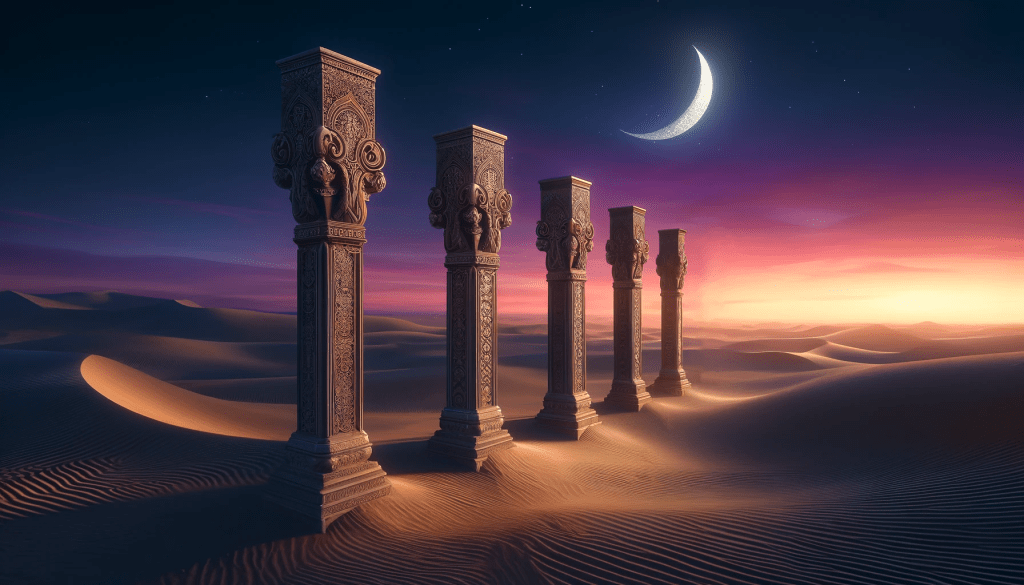
The essential practices required to live as a devout Muslim are known as “the Five Pillars of Islam.” These core obligations include declaring the profession of faith (shahada), performing the five daily prayers, giving alms to those in need, fasting during the holy month of Ramadan, and, if feasible, making a pilgrimage to Mecca.
The First Pillar – The Shahada
The most fundamental religious act in Islam is the profession of faith, expressed in the declaration: “La ilaha illa Allah; Muhammad rasul Allah” (There is no deity but Allah; Muhammad is the messenger of Allah). This declaration, known as the shahada, holds profound significance in a Muslim’s life. It is traditionally the first words whispered into the ears of a newborn Muslim and often the last words recited by a dying believer. Devout Muslims strive to repeat this powerful affirmation frequently throughout their day, as its sincere utterance is what defines and affirms one’s identity as a Muslim.
The Second Pillar – Salaht (Daily Prayers)
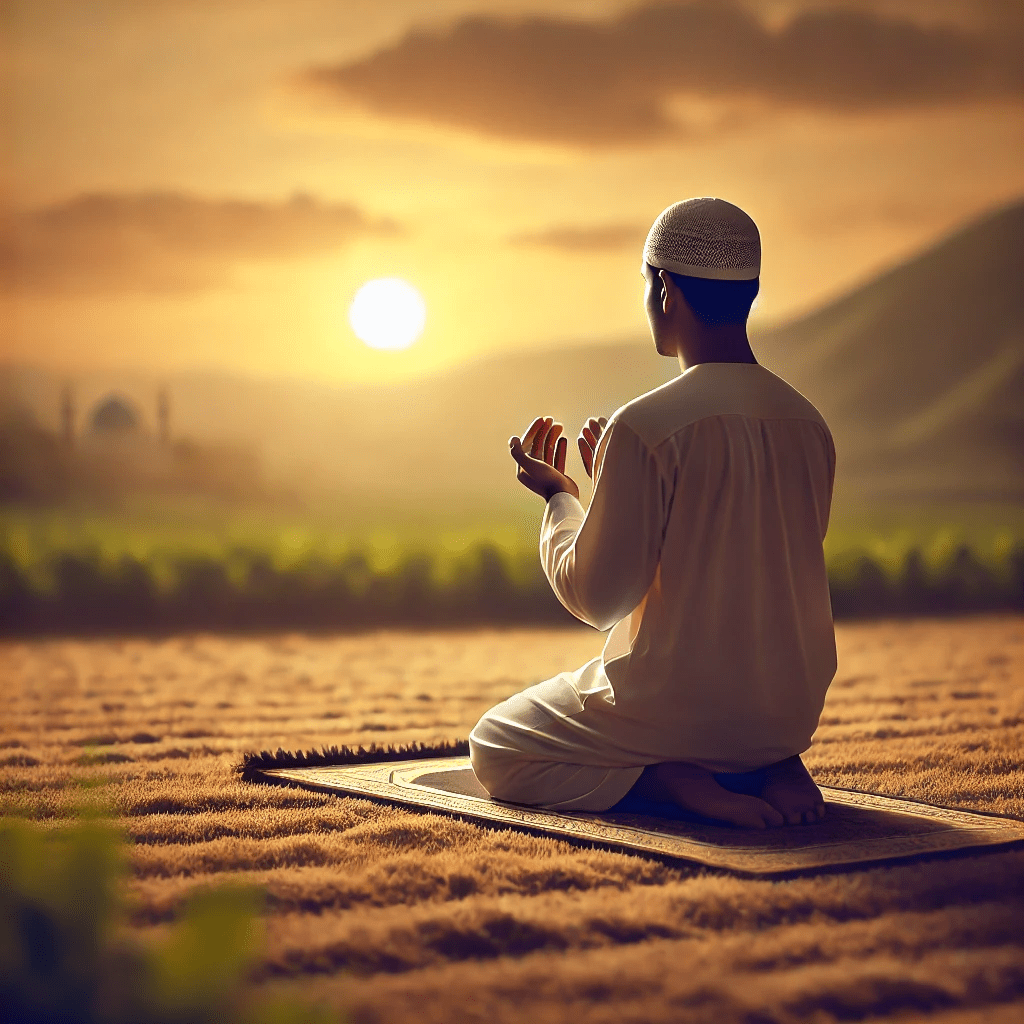
Muslims are required to pray at least five times a day at specific times: dawn (Fajr), midday (Dhuhr), mid-afternoon (Asr), sunset (Maghrib), and nightfall (Isha). In many Muslim communities, the call to prayer (adhan) is announced by a muezzin, traditionally from the top of elegant towers called minarets. In smaller communities, the call may be made from the entrance of local mosques. Wherever Muslims are, they pause to perform the prescribed prayers.
Before praying, Muslims must cleanse themselves of physical impurities through a ritual called ablution (wudu). This involves washing the hands, face, and feet. Most mosques are equipped with washing facilities for this purpose. In situations where water is unavailable, Muslims may use clean sand or soil in a symbolic act of purification known as tayammum.
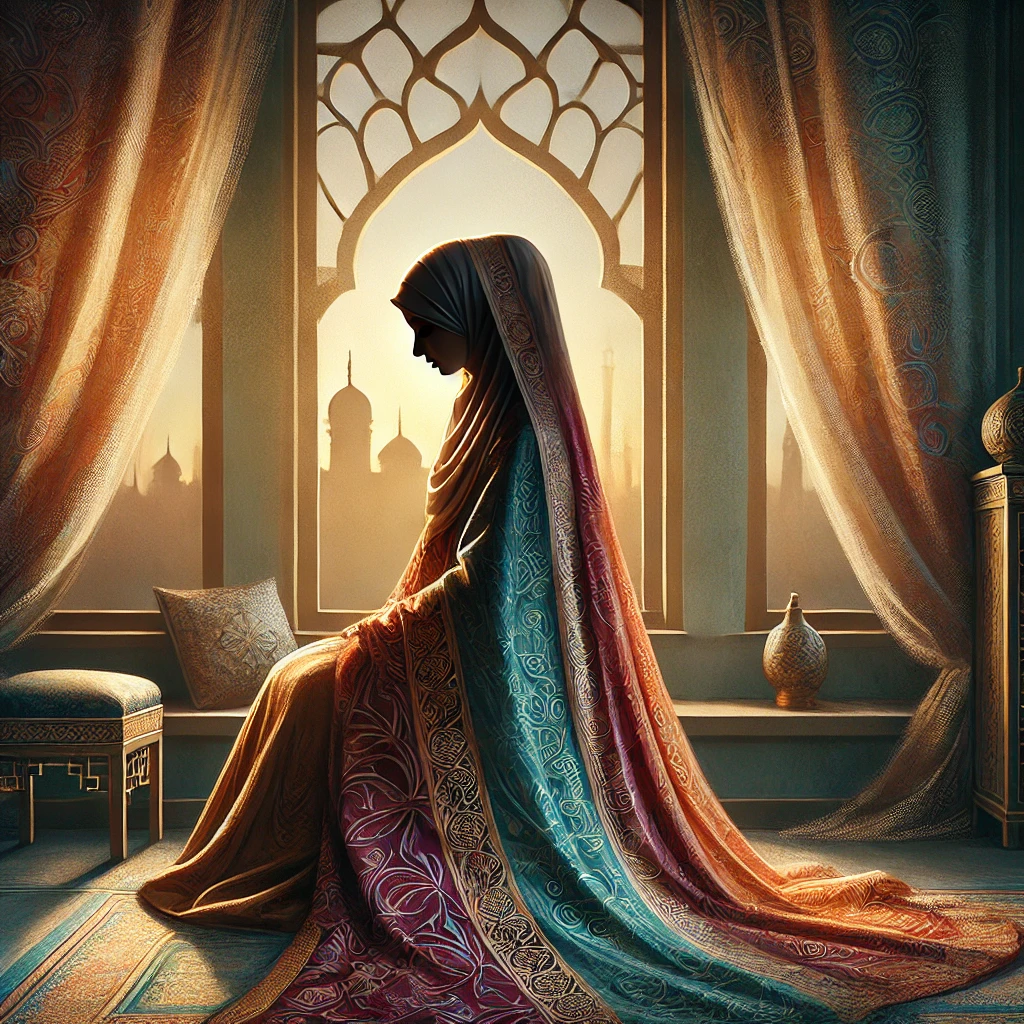
During prayer, worshipers face Mecca and perform a series of prostrations and recitations. It is customary for men and women to pray separately. Some mosques are exclusively for men, while others provide designated areas for both genders. In some cultures, women are not obligated to attend communal prayers in mosques, as they may prioritize caring for children, managing household responsibilities, or attending to their own health. Praying at home is considered equally valid for women, reflecting flexibility in Islamic practice to accommodate different circumstances.
The Third Pillar – Zakaht (Almsgiving)
Muslims are obligated to share their wealth with those in need, including the poor, widows, orphans, and the elderly. This act of charity, known as almsgiving (zakat), may also be directed toward supporting religious institutions that provide aid on a larger scale, as well as benefiting scholars and students. Charity is not merely encouraged but is a requirement under Islamic law, assessed as a tax ranging from 2.5% to 10% of an individual’s wealth, depending on the type of assets.
Islam places great emphasis on the dignity of both giving and receiving alms, viewing both as acts that invite God’s blessings. Unlike in some societies, begging is not seen as dishonorable in Islam when it arises from genuine need. The spirit of zakat fosters a sense of communal responsibility and compassion, ensuring that wealth is redistributed to support those less fortunate.
The Fourth Pillar – Sawm (Fasting)
Many religions include fasting as part of their observances, though it is often brief or limited. For example, Jews fast on the Day of Atonement (Yom Kippur), while Roman Catholic Christians observe certain fast days and abstain from eating meat during Lent. Islam, however, prescribes one of the longest and most rigorous fasts. Each year during the holy month of Ramadan, Muslims fast from dawn to sunset, refraining from eating, drinking, smoking, and engaging in intimate relations during daylight hours.
This fast is observed in commemoration of the month when the Prophet Muhammad (ﷺ) first received divine revelation. Because the Islamic calendar is lunar, Ramadan shifts each year, occasionally falling during summer, when fasting from food and water in the long, hot days can be especially challenging. According to Islamic tradition, the fast begins at dawn, marked by the moment one can distinguish a black thread from a white thread in the morning light. It ends at sunset when these threads can no longer be distinguished.
Certain groups are exempt from fasting, including the sick, travelers, nursing mothers, and children. However, they are encouraged to compensate for missed fasts at a later time or provide meals to those in need as an alternative.
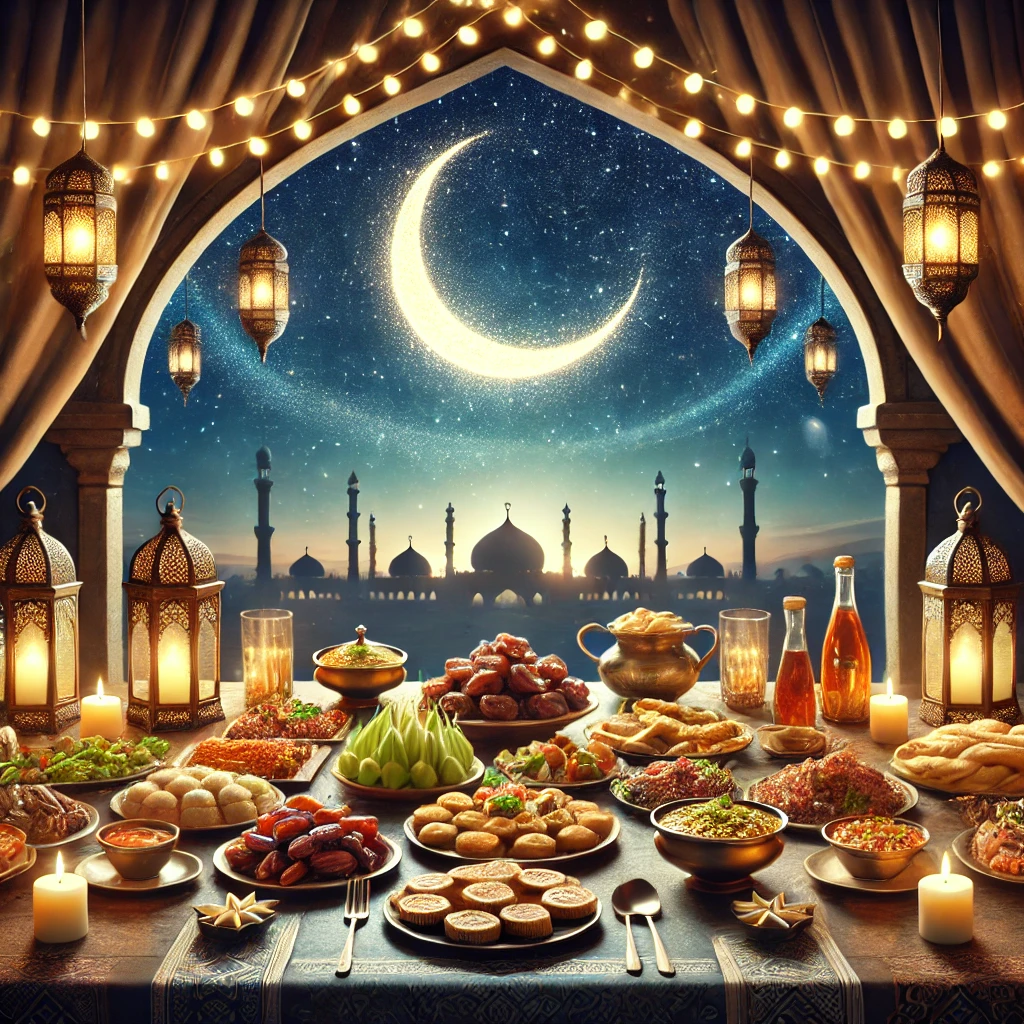
The conclusion of Ramadan is marked by a joyous three-day celebration known as Eid al-Fitr, during which families gather, share meals, and give thanks. Completing the Ramadan fast is believed to bring spiritual purification and forgiveness of sins, reflecting the mercy and blessings of Allah.
The Fifth Pillar – Hajj (Pilgrimage)
The pilgrimage to Mecca, known as the Hajj, has deep historical roots, originating as a central ritual in the pre-Islamic Arab religion. It played a significant role in the early history of Islam and is described in the Qur’an as a fundamental duty for Muslims. The Prophet Muhammad (ﷺ) purified the Kaaba of its idols and, according to Islamic tradition, restored it as a shrine dedicated to Allah, the one Creator.
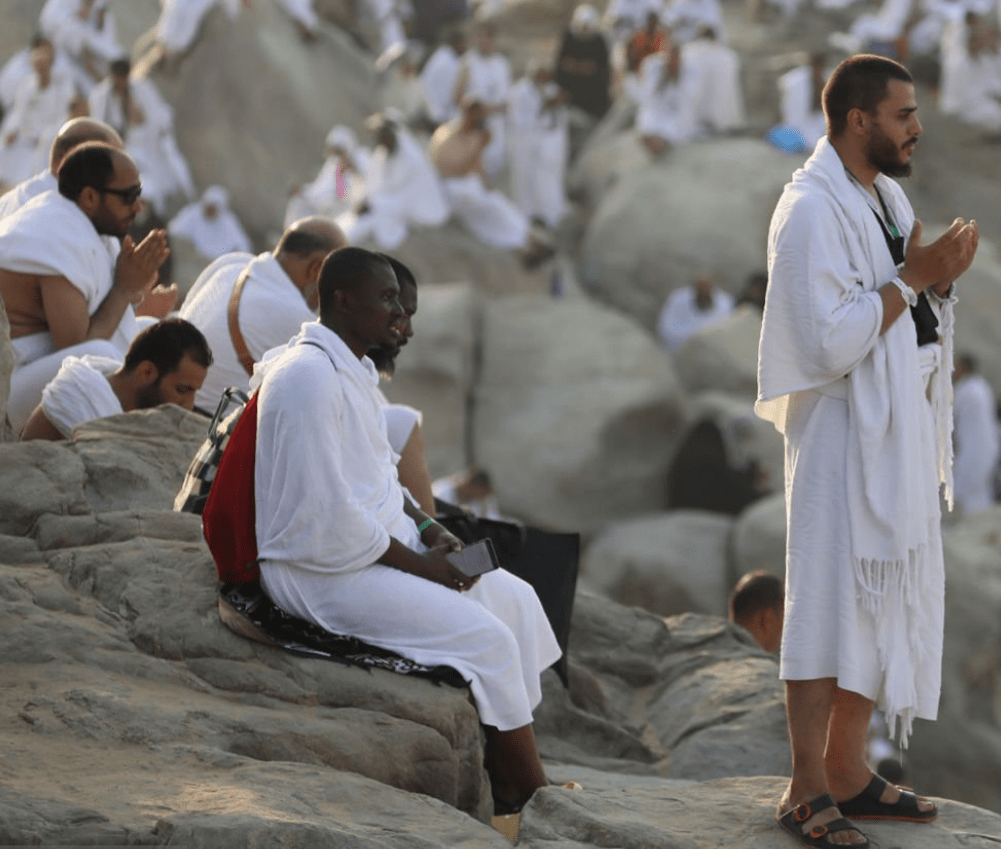
Every Muslim who is physically and financially able is required to perform the Hajj once in their lifetime. This sacred pilgrimage occurs during the Islamic lunar month of Dhu al-Hijjah, attracting millions of Muslims from around the world. For many, the journey represents a profound spiritual commitment, with some using their life savings to make the trip. Before modern transportation, the journey was arduous, and for the elderly or infirm, it often became a one-way trip, regarded as a blessed way to meet one’s end while fulfilling a divine obligation.
Upon reaching the outskirts of Mecca, pilgrims leave behind their modes of transport and complete the journey on foot. They don simple garments and sandals: men wear unstitched white cloth without head coverings, while women dress modestly in plain clothing. These garments eliminate distinctions of wealth or status, emphasizing equality before God. During much of the Hajj, pilgrims abstain from food, drink during daylight hours, intimate relations, and cutting of the hair and nails.
Key rituals during the Hajj include visiting the sacred Zamzam well, believed to have been provided by Allah to Hagar and her son Ishmael. Pilgrims perform Tawaf by circling the Kaaba seven times and, if possible, kiss the sacred black stone embedded in its wall. On the tenth day, they offer an animal sacrifice, often a sheep or goat, commemorating Abraham’s willingness to sacrifice his son in obedience to God’s command.
The pilgrimage often extends to Medina, where pilgrims pay their respects at the Prophet Muhammad’s (ﷺ) grave and visit his mosque. Upon returning home, Muslims who have completed the Hajj are honored with the title Haji or Hajjah, signifying their fulfillment of this profound religious obligation. This title serves as a lifelong reminder of their devotion and achievement.
Because the Quran is the word of God, its messages are the authority of all Muslims. The religion of Islam demands strict monotheism and that Muslims recognize the oneness of God and that God is the sole creator of everything. Unlike the early polytheists of Mecca and the Byzantine Christians who were in dispute over what part Jesus (ﷺ) played in the Godhead, Muslims believe that there is only one God, complete, eternal, and undivided. Of all the other Religions in the entire world, only Judaism insists on such absolute monotheism.
Quran 112 Al Ikhlas (The Sincerity)
Say: He is God, One, God, the everlasting Refuge, Who has not begotten, And has not been begotten And equal to Him is none.
Allah (God’s) role as an omnipresent, omniscient, and omnipotent creator of the universe is heavily emphasized in the Quran.
Quran 7:54 (The Heights)
Indeed, your Lord is Allah, Who created the heavens and the earth in six Days, then established Himself on the Throne. He makes the day and night overlap in rapid succession. He created the sun, the moon, and the stars—all subjected to His command. The creation and the command belong to Him ˹alone˺. Blessed is Allah, Lord of all worlds!
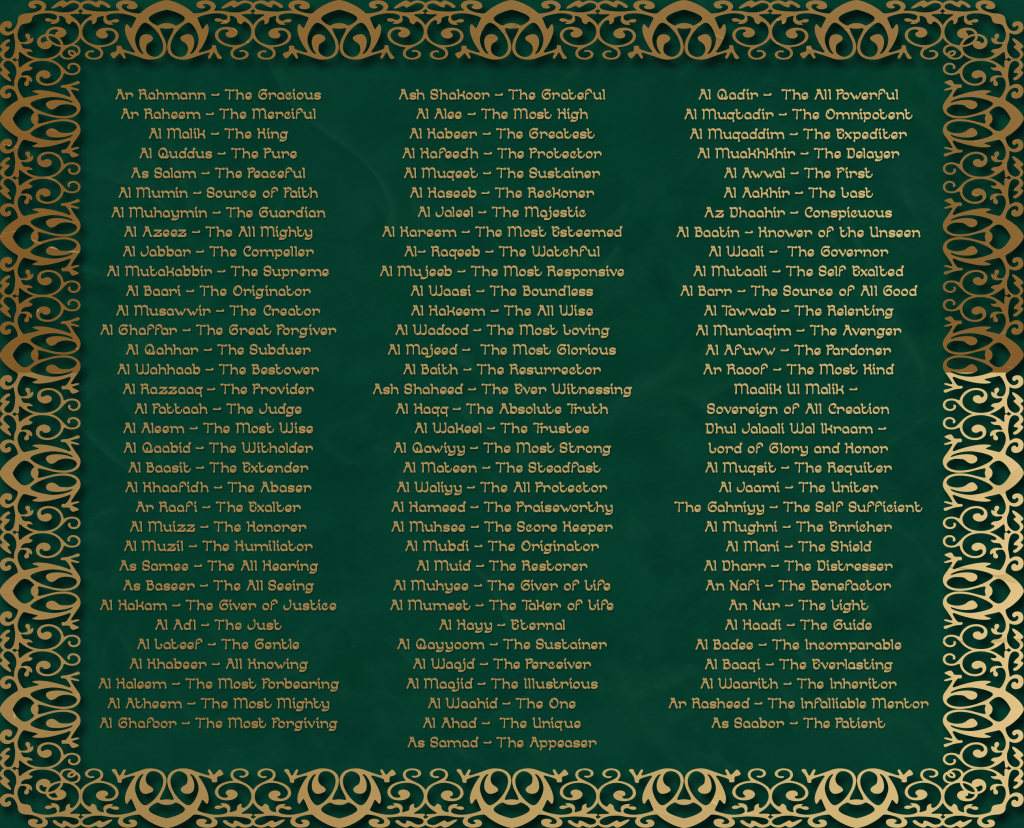
According to Muslim tradition, Allah has 99 names. Devout Muslims repeat these names in a manner similar to that of a Roman Catholic reciting the rosary.
Although Allah possesses the characteristics of power, sovereignty, and majesty, Allah is also characterized by justice and mercy. Allah will repay evil with justice, and righteousness with mercy.
The mercy of God is often emphasized in Muslim worship and practice. It is traditional for a Muslim who is giving a speech or writing to begin with the words, ‘In the name of God, the Merciful and Compassionate.’
‘Indeed, it is We who sent down the Qur’an and indeed, We will be its guardian.’ -Quran ‘Al-Hijir’ Verse 9
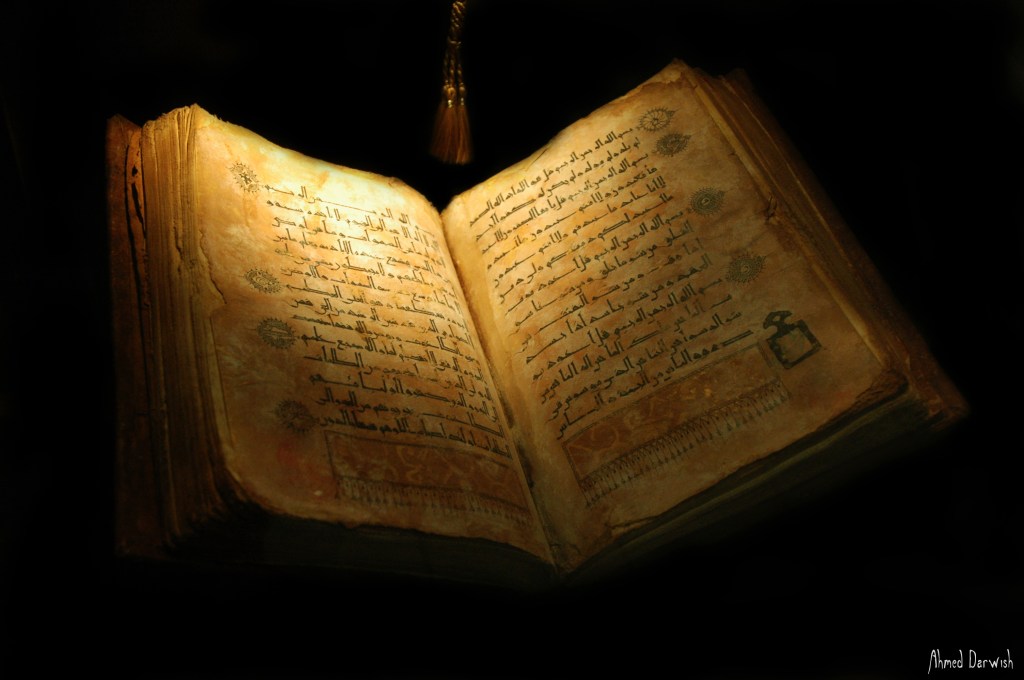
The scripture is Islam is called the ‘Quran.’ The word Quran means both ‘reading’ and ‘recitation.’ Muslims believe that the Quran is a recitation of an eternal scripture, written in heaven and revealed, chapter by chapter, to the Prophet Muhammad (ﷺ). The title of the scripture also relates to the first Surah (chapter), which is ‘Recite in the name of thy Lord who created…’
It can be argued that no scripture in the history of the world has been so influential to its people. Surely no scripture has been read as much or committed to memory as often. Although Jewish and Christian people revere their scripture, human, though inspired, authorship is acknowledged. Such is not the case with the Quran. The Quran is the direct word of God. It is eternal, absolute, and irrevocable. The Quran is believed to be God’s last word to humanity. Islam respects the Jewish and Christian scriptures, but the Quran is understood as God’s final message.
The Quran was revealed to Muhammad verbally, as he committed it to memory. Ever since it has remained unaltered and unchanged. The Quran of today is the exact same Quran at the time of the Prophet Muhammad. This is the miracle of the Quran itself, as God promised that it would be protected from corruption.
Recitation of the Quran is an important ritual and the source of God’s blessing because it produces his divine speech. Customarily, the first thing a Muslim infants hear when they are born is verses from the Quran. These verses are often gently chanted in their ears. Beautiful calligraphy verse from the Quran adorns the walls of the homes of Muslims. And its verses are often the last thing Muslims hear before death.
Among Muslims, it is considered a supreme act of piety and devotion to commit the entire Quran to memory. Those who achieve this extraordinary feat are given the honorary title of ‘Hafiz.’
The Quran is considered the exact words of God. The revelations that make up the Quran are organized into 114 chapters called ‘Surahs.’ The Surahs contain about 6,000 verses, called ‘Ayats.’ There is no topical or chronological order to the Quran. They are arranged based on the length of the Surah in descending order. The longest Surah contains 287 Ayats, and the shortest only contains 3.
Clicking on the Quran button below will take you to an online Quran hosted on quran.com
In the celestial realms where angels soared and stars danced, a profound event unfolded, shaping the destiny of humanity. It was a tale woven into the fabric of Islamic lore, a story of divine intervention and guidance bestowed upon the first of mankind.
Long ago, in the lush embrace of the Garden of Eden, Adam (ﷺ) and Eve (سلام الله علیها) found themselves entrusted with a sacred mission by the Creator Himself. As they roamed amidst the verdant foliage and crystal-clear streams, they sought to establish a place of worship, a sanctuary where they could commune with Allah and offer their gratitude for the blessings bestowed upon them.
One fateful night, as Adam and Eve lay beneath the canopy of stars, a brilliant light streaked across the heavens, illuminating the darkness with its celestial radiance. It was no ordinary meteorite, but a divine manifestation sent by Allah to mark the sacred spot where their altar would stand.
As the meteorite descended from the heavens, its luminous glow bathed the Garden of Eden in a halo of celestial splendor. Adam and Eve watched in awe as it gently touched down upon the earth, embedding itself into the fertile soil with a resounding echo that reverberated throughout the heavens.
With hearts full of reverence and gratitude, Adam and Eve approached the site where the meteorite had landed, knowing it to be a sign from their Lord. They knelt upon the ground and prostrated themselves as they pledged to honor Allah’s guidance and build their altar upon this hallowed ground.
In the days that followed, Adam and Eve labored tirelessly to construct their altar, fashioning it from the finest materials the Garden of Eden had to offer. With each stone placed and each pillar raised, they felt the presence of Allah guiding their hands, infusing their creation with divine grace and purpose.
When the altar was finally complete, it stood as a testament to their unwavering faith and devotion to Allah. From its humble beginnings as a simple structure of stone and earth, it grew to become a beacon of light and hope for all of humanity, a sacred place where believers would gather to seek solace and guidance from their Creator.
And so, in the heart of the Garden of Eden, beneath the watchful gaze of angels and stars alike, Adam and Eve’s altar stood as a symbol of their eternal bond with Allah.
As centuries passed, the white meteorite that had once graced the Garden of Eden with its celestial purity began to undergo a transformation unlike any other. Slowly but surely, the radiant glow that had once emanated from its surface began to dim, replaced by a deepening shade of ebony that seemed to swallow the light itself.
The once-pristine meteorite gradually darkened, its surface marred by the weight of humanity’s transgressions. The meteorite was absorbing the sins of all who touched it, becoming a vessel for the collective burdens of mankind.
As generations passed and the descendants of Adam and Eve spread across the earth, the meteorite became a symbol of both divine mercy and human frailty. Pilgrims from far and wide would journey to the sacred site where the meteorite lay, seeking forgiveness and redemption for their sins, their tears mingling with the darkened stone as they prayed for Allah’s mercy. And yet, despite its transformation into a somber hue, the meteorite retained a trace of its former brilliance, a glimmer of celestial light that shone forth from within the depths of its ebony surface.
In the end, the meteorite serves as a testament to the resilience of faith and the power of redemption. Though it bore the weight of humanity’s sins upon its shoulders, it remained a beacon of hope in a world fraught with darkness, guiding believers toward the path of righteousness and enlightenment. And so, as the ages passed and civilizations rose and fell, the meteorite remained a silent witness to the trials and triumphs of humanity, a tangible reminder of the boundless mercy and compassion of Allah. And though its surface may have turned black as night, its essence remained pure and untarnished, a testament to the enduring power of faith in the face of adversity.
The English word ‘religion’ is derived from the Latin word ‘religio,’ which refers to the fear or awe one feels in the presence of a spirit or deity. Most of the religions that have existed have probably been more concerned with humanity’s proper relationship to supernatural beings and pleasing them, rather than with the well being and ethical relationships among people. Ironically, most adherents to religions associate the word ‘religion’ with the word ‘moral,’ but these terms are not actually synonymous.
There is a universality to religion, as wherever people are found, religion is usually found to. Even when we uncover prehistoric civilizations, we usually find altars, cave paintings, and ritualistic burial practices that reveal our religious nature.
Where does religion come from? Some believe that human beings developed religion to make sense of the natural world around them. Some others believe that religion was devised to control and suppress the masses. Another theory is that religion was born out of our psychological fears and/or social needs. Perhaps all these theories are correct.
There are four main theories of religion: the Animistic Theory, the Nature Worship Theory, the Theory of the Original Monotheism, and the Magic Theory.
ANIMISTIC THEORY
The animistic theory is an understanding that human beings developed a practice of ancestor worship or veneration, in which one attends the spirits of the dead. It is believed that an awareness of the existence of spirits in nature led to the worship of various aspects of nature: water, trees, stones, etc… Ultimately, this animistic view of the universe produced the polytheistic religions that worshiped sky, earth, and water deities.
NATURE WORSHIP THEORY
It is believed by some anthropologist that some human beings developed religion from their observations of the forces of nature. People became aware of the regularity and predictability of the seasons, the tides, and the phases of the moon. There response to these forces of nature was to personalize them. Thus they gave names to the sun, moon, etc…, and began to weave tales about them which became mythology. Eventually pantheons and religions were developed around these myths.
THE THEORY OF THE ORIGINAL MONOTHEISM
Some anthropologist studied hunter-gatherer/foraging cultures (which are considered in the field to be very similar to oldest forms of human society). It was notable that most known hunter-gatherer cultures have a common belief in a distant high god. Even though their religions may have animistic and polytheistic characteristics, there always seems to be belief in one ‘great’ or ‘superior’ creator god. Usually this high god is understood to be eternal, having omniscience, beneficence, morality, and omnipotence.
THE MAGIC THEORY
Regarding magic theory, it is believed that early human beings attempted to control the natural world through magic. When humans realized that nature could not be controlled with magic, they developed religion instead. This logic seemed to imply that nature can be implored to cooperate. When religion could not manipulate nature either, it is believed that human beings began to turn to science, as they began to understand that nature is operative.
*This page is still under development. Eventually you will be able to click on the buttons bellow and it will take you to a page dedicated to that religion. So keep checking back to see if more pages have been added.*
Language is an integral part of culture and plays a crucial role in its development and transmission. Language reflects the values, beliefs, and perceptions of a culture; and provides a way to express a culture, transmit cultural norms, values, and traditions from one generation to the next. Language also shapes our perceptions of the world, giving us a sense of identity and belonging to a particular cultural group.
In essence, language both reflects and shapes the values, beliefs, and identity of a society, while culture provides the context and meaning through which language is understood and interpreted. Therefore, understanding a culture requires understanding its language, and vice versa.
Languages are constantly evolving, as new languages are created and old languages are lost, so it is hard to count how many languages are spoken around the world. It is estimated that at least 7,000 languages are being spoken today. Of these languages, there are about 62 main language families (as shown on the tree above).
A language family is a group of languages that are related through descent from a common ancestral language or parental language, called the proto-language of that family. Languages within a family share a significant number of common features in phonology, morphology, and syntax. Subdivisions of a language family are called “branches”. Some families contain hundreds of different languages, while some languages, termed isolates, are not known to be related to any other languages and therefore constitute a family consisting of only one language.
*This page is still under construction. Eventually, you will be able to click on the language families below and be taken to that language family’s page. Keep visiting to see when more pages are added.*





















 Vault of Stones