This is actually an all humanities blog. This community is for History, Anthropology. Culture, Archaeology, Theology, Philosophy, Literature and Linguistics.
Islam began among the desert Arabian people in the 7th century C.E. It did not spring out of a religious vacuum. The people in this region followed and were exposed to various religions. Christianity had been very familiar to the the people. Judea, the home of Christianity was not far from Arabia. Damascus, Caesarea, Antioch, and Alexandria were neighbors to Mecca and Yathrib (Medina).
The people of Arabia would have also been familiar with Judaism. Several desert tribes were Jewish. Although the origins of these tribes are unclear, many historians believe that they were the descendants of Jewish people exiled from Judea by the Romans in 70 C.E. and 135 C.E. When the Prophet Muhammad (ﷺ) entered Medina in 622 C.E. many of the residents of the city were Jewish.
Another religion that was prominent at the time in the region was Zoroastrianism. It is possible that Muhammad and some of his disciples engaged with Persian Zoroastrians.
Perhaps the major religious force from which Islam emerged and/or reacted against was the native religion of the Arab people. We know very little about the religions of the Arabs before Islam, as the only record and accounts come from Muslim sources. These are naturally going to be critical of the religions that were replaced.
It was documented that the pre-Islamic people (who were not Jewish or Christian) worshiped a variety of gods, though they recognized one supreme creator deity. who was separate and unapproachable by human beings. They called this deity ‘Allah,’ which translated to ‘The God.’ However, the deities that received the most attention and worship were the local tribal gods. Images of these gods were carved and cherished. Blood sacrifices were made to them. In addition to a great pantheon of the gods of heaven and earth, there were lesser divine creatures. Supernatural beings like angels and faeries were believed to be helpful, and demonic creatures were feared and believed to be harmful.
The most obvious characteristic of some of these religions was they were animistic. The people believed they found gods and supernatural beings in stones, trees, wells, and animals. The city of Mecca became a hub of cultural exchange, especially of animistic ideologies. It was also a trading/caravan depot, where people came to sell and exchange goods from distant lands.
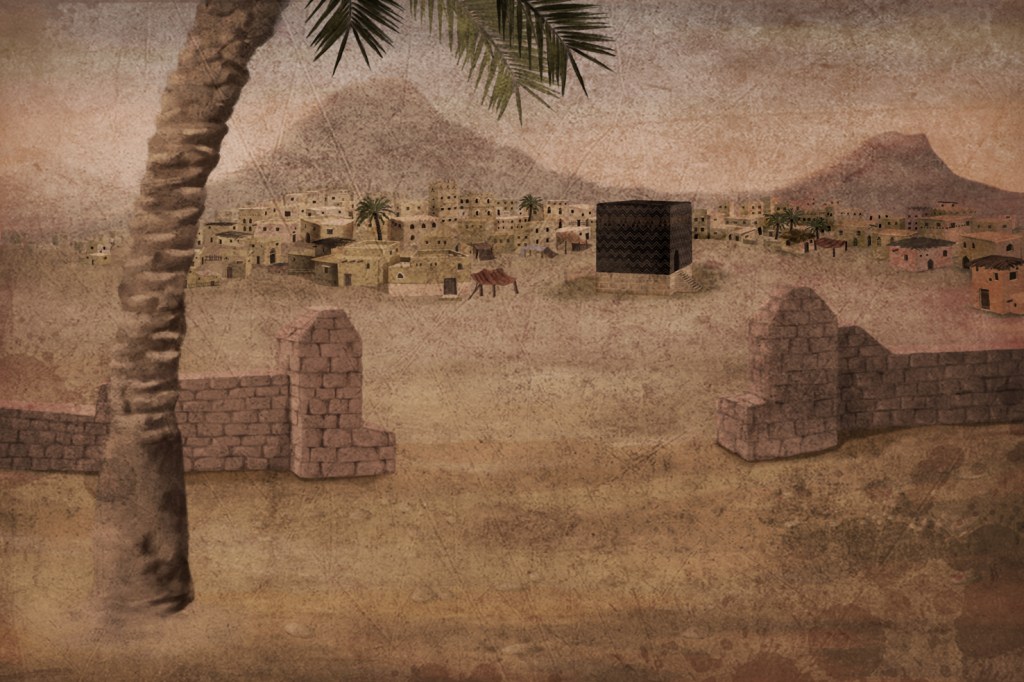
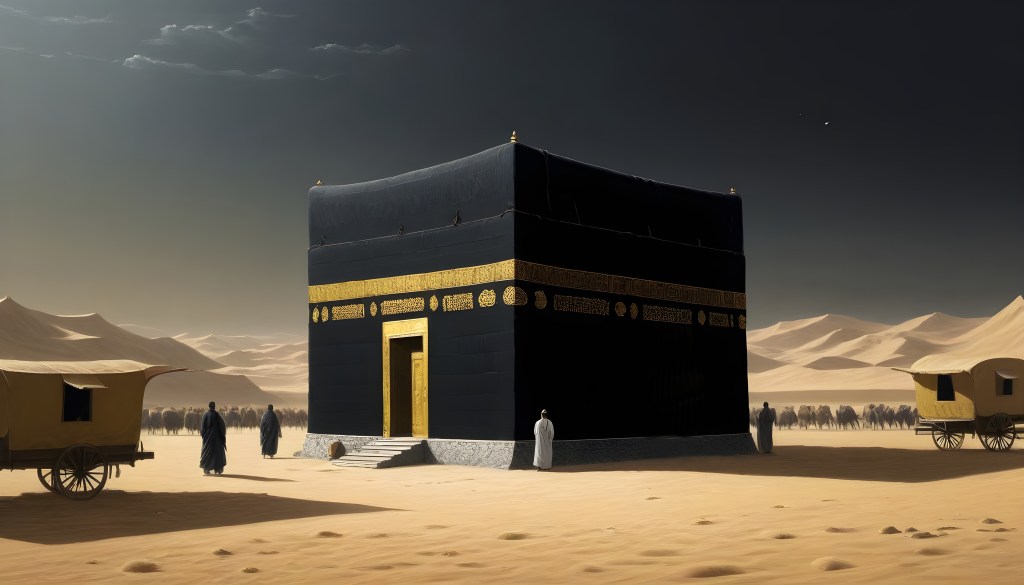
Mecca is located on the central-western coast of Arabia, and in those earlier times, is was along the north and south caravan route. It became famous for the mysterious meteoroic stone than had fallen there centuries before. The stone was an object of veneration to the animistic population. By the time of Muhammad (ﷺ), there was already an enclosure built around this stone. This enclosure was called the Kaaba. Eventually the Kaaba was filled with many relics and icons and other objects revered by the people who traveled there as pilgrims and with trade caravans.
(There is a legend which surrounds the black stone and the Kaaba that houses it. A legend about the prophet Abraham (ﷺ) and his son Ishmael. See: Legend of Al-Hajaru Al-Aswad and The Story of the Kaaba.)
The story of the Kaaba is a story about the Prophet Arbraham (ﷺ) and his eldest son, Ishmael (ﷺ).
THE GREAT TEST OF FAITH
The Prophet Abraham (ﷺ), known for his steadfast devotion to Allah and his unwavering commitment to righteousness, found his faith tested in ways unimaginable. His journey began with a vision, a divine revelation from Allah instructing him to sacrifice his beloved son, Ishmael (ﷺ), as a test of his devotion.
Though shaken to his core by the weight of this divine command, Abraham did not hesitate to heed the call of his Lord. With a heavy heart and tears streaming down his face, he approached Ishmael and shared with him the solemn news, preparing to fulfill Allah’s will with unwavering obedience.
Ishmael, ever the epitome of faith and submission, accepted his father’s decision with grace and humility, understanding that it was Allah’s decree and that their sacrifice was an act of devotion beyond measure. Together, father and son embarked on a journey to fulfill Allah’s command, their hearts united in faith and surrender to the divine will.
When they reached the appointed spot, a desolate hill overlooking the sacred city of Mecca. With trembling hands and steadfast hearts, Abraham prepared to carry out the sacrifice, his love for Ishmael mingling with his unwavering devotion to Allah. Just as Abraham raised his hand to fulfill the divine command, Allah intervened with a miraculous decree. In place of Ishmael, a ram appeared, its horns caught in a thicket, offering itself as a substitute for the sacrifice.
In that moment, Abraham and Ishmael were overcome with gratitude and relief, their faith affirmed and their bond strengthened by the mercy of Allah. They offered thanks to their Lord for His divine intervention, acknowledging that He alone is the source of all mercy and compassion.
THE WELL OF ZAMZAM
As the sands of time shifted and the pages of history turned, another chapter unfolded in the lives of Prophet Abraham (ﷺ) and his beloved son Ishmael (ﷺ).
After Ishmael’s miraculous rescue from the intended sacrifice, Abraham faced another moment of trial and tribulation. As commanded by Allah, he made the difficult decision to send Ishmael and his mother, Hagar (سلام الله علیها), into the barren desert wilderness surrounding the sacred city of Mecca. Abraham entrusted Ishmael and Hagar to the care of Allah, knowing that their journey into the unknown was guided by divine providence. With faith as their compass and hope as their sustenance, mother and son set forth into the desert, their footsteps echoing across the vast expanse of sand and stone.
Days turned into nights, and the relentless sun beat down upon them with unyielding intensity. Thirst parched their throats, and hunger gnawed at their bellies as they wandered through the unforgiving terrain. Yet, in the depths of their despair, they clung to the promise of Allah’s mercy, trusting that He would not abandon them in their time of need.
And then, in a moment of divine intervention, Allah revealed His boundless grace to Hagar and Ishmael. As Ishmael lay crying out of thirst, Hagar desperately searched for water, running between the hills of Safa and Marwa in search of relief. It was then that Allah, in His infinite wisdom, performed a miracle that would echo through the ages.
From beneath the earth, a spring of fresh, cool water gushed forth, quenching Ishmael’s thirst and bringing newfound hope to Hagar’s heart. It was a miraculous well, known as Zamzam, whose waters would flow for generations to come, providing sustenance and solace to pilgrims from all corners of the earth.
With gratitude overflowing in their hearts, Hagar and Ishmael drank deeply from the blessed waters of Zamzam, their spirits renewed and their faith reaffirmed. They knew that Allah had heard their prayers and answered them in ways beyond their wildest imagination, guiding them through the wilderness with His divine providence.
THE BUILDING OF THE KAABA
After the miraculous revelation of Zamzam, Hagar (سلام الله علیها) and Ishmael (ﷺ) thrived in the desert, their lives sustained by the abundant blessings bestowed upon them by Allah. As Ishmael grew into a man of strength and wisdom, his faith remained steadfast, rooted in the teachings of his father, Prophet Abraham (ﷺ).
Meanwhile, Abraham, guided by Allah’s wisdom and divine providence, embarked on a journey of his own. Years passed, and his heart yearned to reunite with Ishmael, to see the son he had once feared lost to the sands of the desert. And so, heeding the call of his Lord, Abraham set forth once more, his footsteps guided by faith and hope.
Upon his return to the desert of Mecca, Abraham was greeted with joyous embraces and tears of gratitude by Ishmael and Hagar. Together, they rejoiced in the countless blessings bestowed upon them by Allah, their hearts overflowing with love and gratitude for His boundless mercy.
But their reunion was not merely a moment of celebration; it was also a divine calling to fulfill the sacred purpose ordained by Allah. With Abraham’s guidance, Ishmael and Hagar embarked on the monumental task of constructing the Kaaba, the sacred House of Allah destined to become the focal point of pilgrimage for generations to come.
Guided by the vision of Prophet Abraham and inspired by the divine guidance of Allah, Ishmael and Hagar labored tirelessly to build the Kaaba from the stones and sands of the desert. With each stone laid and each pillar raised, they felt the presence of Allah guiding their hands, infusing their creation with divine grace and purpose.
As they constructed the Kaaba, they incorporated the Black Stone into one of its corners. The stone, which was originally much larger, over time, was broken into several pieces. One of these pieces marked the post where they were Allah wanted them to build the Kaaba. They laid the foundations of the Kaaba first, positioning the Black Stone in its designated corner, and then proceeded to build the walls and roof of the structure around it.
And so, amidst the barren expanse of the desert, the Kaaba rose majestically, a testament to the unwavering faith and devotion of Prophet Abraham, Ishmael, and Hagar. Its sacred walls echoed with the prayers of believers from every corner of the earth, drawing pilgrims to its hallowed sanctuary year after year.
The story of Prophet Abraham, Ishmael, and the Kaaba serves as a timeless reminder of the power of faith, perseverance, and divine providence. Theirs is a legacy that continues to inspire believers to this day, beckoning them to journey to the sacred sanctuary of the Kaaba and seek solace in the presence of Allah, the Most Merciful and Compassionate.
*The Kaaba, the sacred house of worship located in the center of the Grand Mosque in Mecca, is considered by Muslims to be the holiest site on Earth. According to Islamic tradition, the Kaaba was built by Prophet Abraham (Ibrahim) and his son Ishmael (Ismail) under the guidance of Allah. The construction of the Kaaba is intimately linked to the story of the White Meteorite that fell from the sky to mark the spot where Prophet Abraham and Ishmael were instructed to build their altar.
Islamic tradition holds that the Black Stone (Al-Hajar Al-Aswad), a cornerstone of the Kaaba, is the same White Meteorite that descended from the heavens. It is believed to have been a pristine, pure white stone when it first fell to Earth, marking the sacred site chosen by Allah for the construction of the Kaaba. If you would like to read about the legend of the black stone in the Kaaba, click here: The Legend of Al-Hajaru Al-Aswad
In the celestial realms where angels soared and stars danced, a profound event unfolded, shaping the destiny of humanity. It was a tale woven into the fabric of Islamic lore, a story of divine intervention and guidance bestowed upon the first of mankind.
Long ago, in the lush embrace of the Garden of Eden, Adam (ﷺ) and Eve (سلام الله علیها) found themselves entrusted with a sacred mission by the Creator Himself. As they roamed amidst the verdant foliage and crystal-clear streams, they sought to establish a place of worship, a sanctuary where they could commune with Allah and offer their gratitude for the blessings bestowed upon them.
One fateful night, as Adam and Eve lay beneath the canopy of stars, a brilliant light streaked across the heavens, illuminating the darkness with its celestial radiance. It was no ordinary meteorite, but a divine manifestation sent by Allah to mark the sacred spot where their altar would stand.
As the meteorite descended from the heavens, its luminous glow bathed the Garden of Eden in a halo of celestial splendor. Adam and Eve watched in awe as it gently touched down upon the earth, embedding itself into the fertile soil with a resounding echo that reverberated throughout the heavens.
With hearts full of reverence and gratitude, Adam and Eve approached the site where the meteorite had landed, knowing it to be a sign from their Lord. They knelt upon the ground and prostrated themselves as they pledged to honor Allah’s guidance and build their altar upon this hallowed ground.
In the days that followed, Adam and Eve labored tirelessly to construct their altar, fashioning it from the finest materials the Garden of Eden had to offer. With each stone placed and each pillar raised, they felt the presence of Allah guiding their hands, infusing their creation with divine grace and purpose.
When the altar was finally complete, it stood as a testament to their unwavering faith and devotion to Allah. From its humble beginnings as a simple structure of stone and earth, it grew to become a beacon of light and hope for all of humanity, a sacred place where believers would gather to seek solace and guidance from their Creator.
And so, in the heart of the Garden of Eden, beneath the watchful gaze of angels and stars alike, Adam and Eve’s altar stood as a symbol of their eternal bond with Allah.
As centuries passed, the white meteorite that had once graced the Garden of Eden with its celestial purity began to undergo a transformation unlike any other. Slowly but surely, the radiant glow that had once emanated from its surface began to dim, replaced by a deepening shade of ebony that seemed to swallow the light itself.
The once-pristine meteorite gradually darkened, its surface marred by the weight of humanity’s transgressions. The meteorite was absorbing the sins of all who touched it, becoming a vessel for the collective burdens of mankind.
As generations passed and the descendants of Adam and Eve spread across the earth, the meteorite became a symbol of both divine mercy and human frailty. Pilgrims from far and wide would journey to the sacred site where the meteorite lay, seeking forgiveness and redemption for their sins, their tears mingling with the darkened stone as they prayed for Allah’s mercy. And yet, despite its transformation into a somber hue, the meteorite retained a trace of its former brilliance, a glimmer of celestial light that shone forth from within the depths of its ebony surface.
In the end, the meteorite serves as a testament to the resilience of faith and the power of redemption. Though it bore the weight of humanity’s sins upon its shoulders, it remained a beacon of hope in a world fraught with darkness, guiding believers toward the path of righteousness and enlightenment. And so, as the ages passed and civilizations rose and fell, the meteorite remained a silent witness to the trials and triumphs of humanity, a tangible reminder of the boundless mercy and compassion of Allah. And though its surface may have turned black as night, its essence remained pure and untarnished, a testament to the enduring power of faith in the face of adversity.
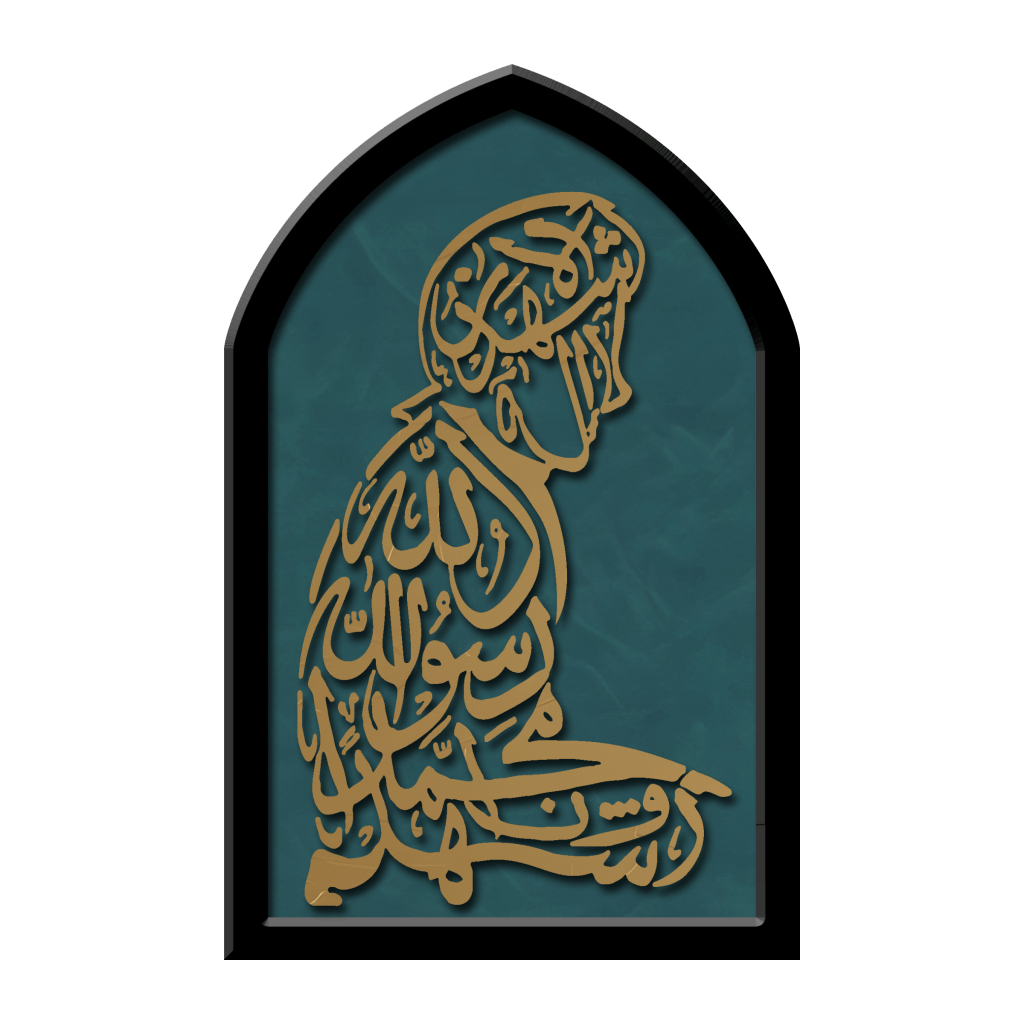
‘There is no deity aside from Allah and Muhammad is the messenger of Allah.’ -The Shahada
One of the youngest of the world’s major religions is Islam. It is also one of the largest, with almost two billion adherents. This is about 24% of the world’s population. There are around 50 countries in the world whose populations are mostly Muslim. Islam is the dominant religion in Asia and Africa.
The basis of Islamic belief is strict monotheism. There is only one God – one deity – who is the creator of all the seen and unseen. God is also transcendent, all knowing and everywhere at all times (omnipresent), all powerful and unrestricted (omnipotent), immortal, merciful, and just. In Islam, God is also conceived as panentheistic, meaning God’s omnipresence transcends space and time.
Muslims believe that even though Allah (God) was known by other Jewish and Christian prophets, and is worshiped by them too, his final revelation was to the Prophet Muhammad (ﷺ). Islam teaches that a person has just one life to live. How believers live this life determines how they will spend their eternal existence. During this life, believers must submit to the will of Allah. Thus, adherents of this religion are called ‘Muslims’ (those who submit to God).
*This page is still under construction. In time, links will be added below. Keep checking back to see if any new publications have been linked.*
Born: Undocumented Father: Azwar Al-Asadi Mother: Undocumented Siblings: 1 Known Brother, Dhiraar Ibn Al-Azwar. Spouse: Not documented Children: Not documented Died: 639 in Bilad Al-Sham (Syria)
Khawlah bint al-Azwar was a prominent figure in early Islamic history, known for her bravery, leadership, and contributions to the Muslim community. She was born in the 7th century in what is now Jordan. Khawlah gained fame during the lifetime of the Prophet Muhammad (ﷺ) and later during the Arab expansion. She is memorialized as one of the first female ghazis in Islamic history and is considered one of the most skilled female warriors in the history of the world.
Khawlah’s brother, Dhiraar, was a skilled warrior, and he taught his sister combat skills such as spear and sword fighting, as well as martial arts. Khawlah and her family are among the first families to convert to Islam in Mecca. She and her brother were companions of Prophet Muhammad (ﷺ), and fought in many battles together.
One of the most famous incidents involving Khawlah occurred during the Battle of Ajnadayn, where her brother was captured by Byzantine forces. In an act of courage and determination, Khawlah donned armor and led a rescue mission, displaying exceptional combat skills and rallying the Muslim troops to victory. One of the Rashidun army commanders, Shurahbil ibn Hassana, is reported to have said about her that: ‘This warrior fights like Khalid ibn Walid, but I am sure he is not Khalid.’ This was when many warriors thought she was Khalid Ibn Walid, until he showed up while Khawlah was engaged in combat. During this period, Muslim warriors wrapped themselves in loose riding robes and Bedouin-style keffiyehs. No one knew her identity until after the battle.
Khawlah’s unwavering commitment to Islam and her fearless spirit made her an inspiration for generations to come. She remains a symbol of female empowerment and resilience in Islamic history, celebrated for her bravery and contributions to the early Muslim community.
The English word ‘religion’ is derived from the Latin word ‘religio,’ which refers to the fear or awe one feels in the presence of a spirit or deity. Most of the religions that have existed have probably been more concerned with humanity’s proper relationship to supernatural beings and pleasing them, rather than with the well being and ethical relationships among people. Ironically, most adherents to religions associate the word ‘religion’ with the word ‘moral,’ but these terms are not actually synonymous.
There is a universality to religion, as wherever people are found, religion is usually found to. Even when we uncover prehistoric civilizations, we usually find altars, cave paintings, and ritualistic burial practices that reveal our religious nature.
Where does religion come from? Some believe that human beings developed religion to make sense of the natural world around them. Some others believe that religion was devised to control and suppress the masses. Another theory is that religion was born out of our psychological fears and/or social needs. Perhaps all these theories are correct.
There are four main theories of religion: the Animistic Theory, the Nature Worship Theory, the Theory of the Original Monotheism, and the Magic Theory.
ANIMISTIC THEORY
The animistic theory is an understanding that human beings developed a practice of ancestor worship or veneration, in which one attends the spirits of the dead. It is believed that an awareness of the existence of spirits in nature led to the worship of various aspects of nature: water, trees, stones, etc… Ultimately, this animistic view of the universe produced the polytheistic religions that worshiped sky, earth, and water deities.
NATURE WORSHIP THEORY
It is believed by some anthropologist that some human beings developed religion from their observations of the forces of nature. People became aware of the regularity and predictability of the seasons, the tides, and the phases of the moon. There response to these forces of nature was to personalize them. Thus they gave names to the sun, moon, etc…, and began to weave tales about them which became mythology. Eventually pantheons and religions were developed around these myths.
THE THEORY OF THE ORIGINAL MONOTHEISM
Some anthropologist studied hunter-gatherer/foraging cultures (which are considered in the field to be very similar to oldest forms of human society). It was notable that most known hunter-gatherer cultures have a common belief in a distant high god. Even though their religions may have animistic and polytheistic characteristics, there always seems to be belief in one ‘great’ or ‘superior’ creator god. Usually this high god is understood to be eternal, having omniscience, beneficence, morality, and omnipotence.
THE MAGIC THEORY
Regarding magic theory, it is believed that early human beings attempted to control the natural world through magic. When humans realized that nature could not be controlled with magic, they developed religion instead. This logic seemed to imply that nature can be implored to cooperate. When religion could not manipulate nature either, it is believed that human beings began to turn to science, as they began to understand that nature is operative.
*This page is still under development. Eventually you will be able to click on the buttons bellow and it will take you to a page dedicated to that religion. So keep checking back to see if more pages have been added.*
Language is an integral part of culture and plays a crucial role in its development and transmission. Language reflects the values, beliefs, and perceptions of a culture; and provides a way to express a culture, transmit cultural norms, values, and traditions from one generation to the next. Language also shapes our perceptions of the world, giving us a sense of identity and belonging to a particular cultural group.
In essence, language both reflects and shapes the values, beliefs, and identity of a society, while culture provides the context and meaning through which language is understood and interpreted. Therefore, understanding a culture requires understanding its language, and vice versa.
Languages are constantly evolving, as new languages are created and old languages are lost, so it is hard to count how many languages are spoken around the world. It is estimated that at least 7,000 languages are being spoken today. Of these languages, there are about 62 main language families (as shown on the tree above).
A language family is a group of languages that are related through descent from a common ancestral language or parental language, called the proto-language of that family. Languages within a family share a significant number of common features in phonology, morphology, and syntax. Subdivisions of a language family are called “branches”. Some families contain hundreds of different languages, while some languages, termed isolates, are not known to be related to any other languages and therefore constitute a family consisting of only one language.
*This page is still under construction. Eventually, you will be able to click on the language families below and be taken to that language family’s page. Keep visiting to see when more pages are added.*
























 Vault of Stones