Islam differs from Roman Catholic Christianity in its level of organizational structure. One notable reason is that Islam emphasizes personal practice, allowing most religious duties to be performed privately without the need for a clergy or priest. Daily prayers, fasting, charity, and even the pilgrimage to Mecca can be undertaken without direct oversight from religious leaders.
Another contributing factor to Islam’s decentralized structure is the absence of a clearly defined succession plan left by the Prophet Muhammad (ﷺ). Of his children, only his daughter Fatima (رَضِيَ ٱللَّٰهُ عَنْهَا) outlived him, but the Prophet (ﷺ) did not explicitly designate her or anyone else as his successor. The only gesture that hinted at a possible leader was his appointment of Abu Bakr to lead the community in prayer.
Following Muhammad’s (ﷺ) death, confusion arose within the Muslim community regarding leadership. Ultimately, the consensus was reached that Abu Bakr should serve as the first caliph. The term caliph derives from the Arabic word khalifa, meaning “deputy” or “representative.” While the caliph assumed responsibility for governing Muslims in worldly matters, spiritual guidance was entrusted to the Qur’an.
The caliphate is the central unifying institution in the history of Islam. Initially, the caliphs were companions of the Prophet Muhammad (ﷺ), serving as pious leaders of the Muslim community. They were chosen through election or common consent. Over time, however, the caliphate evolved into a hereditary institution, with the role of the caliph resembling that of a monarch.
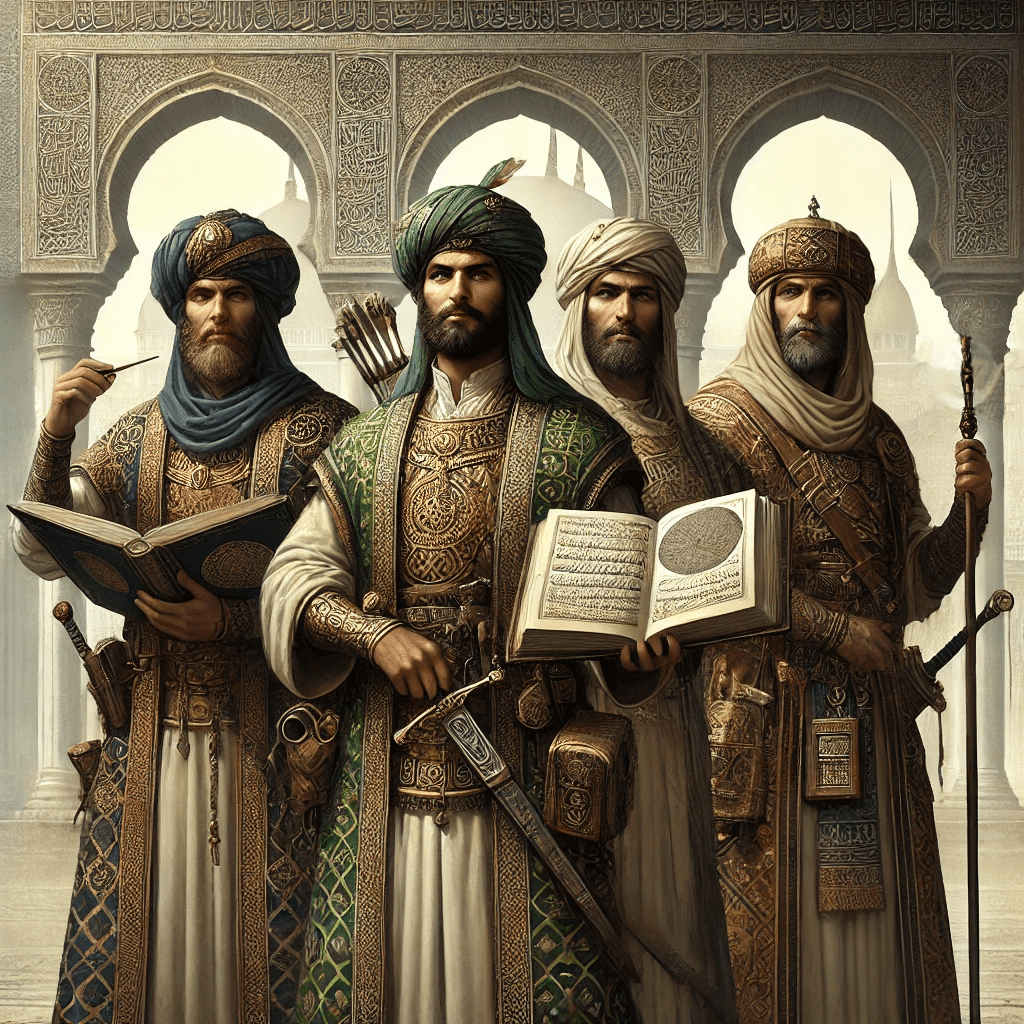
The first four caliphs, often referred to as the “Rightly Guided Caliphs,” were selected from among the Prophet’s (ﷺ) closest companions. They ruled from Arabia and are highly regarded for their adherence to Islamic principles. These caliphs were:
- Abu Bakr (632–634): A close companion of the Prophet (ﷺ), who worked to suppress rebellions and unify the Muslim community following the Prophet’s passing.
- Umar (634–644): Known for his administrative reforms and expansion of the Islamic empire.
- Uthman (644–656): Remembered for commissioning the compilation of the Qur’an into a single, standardized text. Tragically, he was assassinated.
- Ali (656–661): The Prophet’s (ﷺ) cousin and son-in-law, married to his daughter Fatima. His caliphate was marked by internal strife, and in 661, his rule was overtaken by the Umayyads, who established the first Islamic dynasty.
The lives of these early caliphs were fraught with challenges. Abu Bakr faced the daunting task of consolidating a fragile and newly unified Muslim community. Uthman’s assassination highlighted deep divisions within the community, and Ali’s caliphate ended amidst significant turmoil, setting the stage for the dynastic rule of the Umayyads.
Between 661 and 750, the Muslim community, or ummah, was governed by the Umayyad caliphs, who established their capital in Damascus (in present-day Syria). The Umayyads prioritized political power, territorial expansion, and the accumulation of wealth over their role as spiritual leaders of the Muslim community. Their focus on empire-building often drew criticism for neglecting the religious ideals of the caliphate.
The Umayyads were eventually overthrown by the Abbasid dynasty, which ruled from Baghdad between 750 and 1258. The Abbasids surpassed their predecessors in grandeur, ruling with immense pomp and splendor reminiscent of the tales in Arabian Nights. During their reign, a remarkable intellectual and cultural flourishing occurred. Muslims, Christians, and Jews collaborated to study, translate, and preserve the works of Greek philosophers and scientists, ensuring their survival for future generations. This scholarly exchange laid the groundwork for the resurgence of learning in Europe during the Italian Renaissance.
After the 10th century, the golden age of Muslim civilization began to wane, and the caliphate’s power steadily declined. The Abbasid caliphs, once the pinnacle of Islamic authority, were eventually overshadowed and replaced by the Mamluk Turks, who governed the Muslim empire from Egypt.
In the sixteenth century, the Mamluks were themselves supplanted by the Ottoman Turks, who combined the roles of caliph and sultan, making the title of caliph synonymous with political and military leadership under Ottoman rule. However, the glory and influence of the caliphate continued to erode over time.
The final blow came with the collapse of the Ottoman Empire after World War I, marking the official end of the caliphate. By that time, the title of caliph had become largely symbolic, bearing little of the authority or grandeur it held during the Abbasid era.
There have been periodic efforts to restore the caliphate, as some Islamic organizations view it as the only legitimate form of governance for Muslim societies. One such group, Hizb ut-Tahrir, founded in Jerusalem in the 1950s and now based in London, advocates for the restoration of the caliphate through peaceful persuasion and non-violent means.
In contrast, the late Osama bin Laden shared the goal of reviving the caliphate but adopted a starkly different approach. He believed that dismantling the existing system of nation-states could only be achieved through violent means, leading to his pursuit of terrorism as a strategy to achieve this vision.
 Vault of Stones