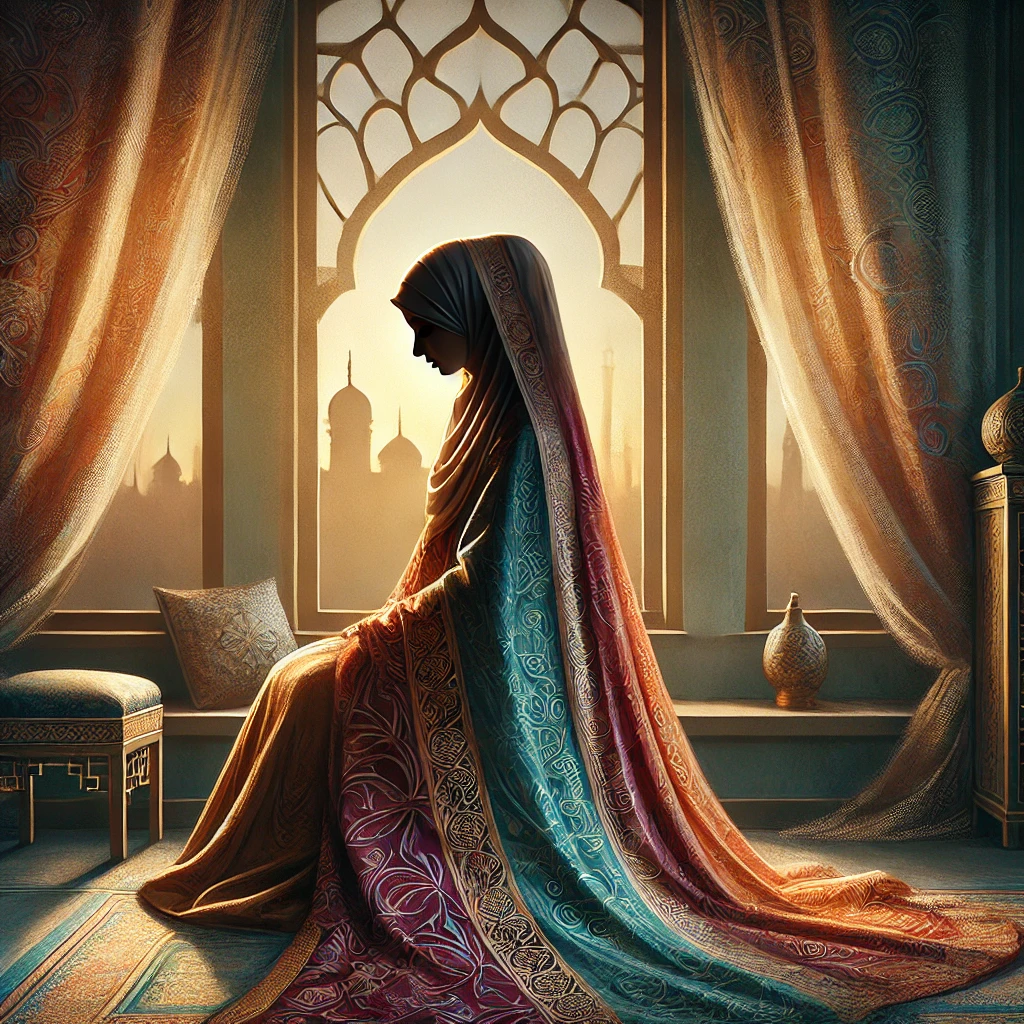
The status of women in pre-Islamic Arabia was significantly low. Practices such as female infanticide were reportedly common to limit the female population. Women were often regarded as property, controlled by their father, husband, or elder brother. A husband could divorce his wife unilaterally, leaving her with no recourse. Exceptions, such as Khadija (رَضِيَ ٱللَّٰهُ عَنْهَا), the first wife of Prophet Muhammad (ﷺ), who managed her own wealth and life, were exceedingly rare. Although Islam did not equalize the status of women and men, it substantially elevated their position in society.
Islam prohibited the practice of infanticide, including the killing of female babies, which had been prevalent in pre-Islamic Arabia. While Islam allowed polygamy to continue, and Prophet Muhammad (ﷺ) took several wives himself, Islam restricted the number of wives a man could have to four, with the conditions that he must be able to provide for them and their children and treat all his wives fairly. In a society where men were frequently killed in battles and marriage was the only socially acceptable state for women, polygamy served as a means of protection and support for women during this time. Many of Prophet Muhammad’s (ﷺ) wives were widows of Muslims who had died in battle.
If a Muslim wished to divorce his wife, it was an easy process compared to modern Western methods. When the husband said, “I divorce you” three times before a witness (talaq), the divorce was final. However, the Muslim woman was not left destitute. She had her possessions and dowry, which the husband paid the wife when the marriage was initially arranged. If there was a divorce, the property and dowry remained the wife’s. In most contemporary Muslim societies, women have the legal right to demand a divorce if their husbands treat them unjustly or cruelly.
Despite the liberalizing aspects of Islam, women are often expected to defer to their fathers, brothers (primarily elder brothers), and husbands, similar to many other religious traditions. The status of women in Muslim societies varies widely, influenced as much by cultural practices as by religious teachings. In countries like Saudi Arabia, Iran, and Afghanistan, women often adhere to stricter regulations regarding dress and public behavior, with some not permitted to work or study alongside men. While Saudi Arabia recently lifted its ban on women driving, restrictions remain under more conservative interpretations of Islamic law. Under the Taliban, women face even more stringent limitations.
Liberal Muslim scholars have criticized these restrictions, arguing that those who impose them are guilty of adding prohibitions not sanctioned by Allah. In contrast, many Asian and African Muslim societies offer women more visible public roles. While modest dress remains the norm, veiling is often regarded as a personal choice. In these more liberal contexts, women who wear head coverings as expressions of Islamic piety actively participate in nearly all areas of public life. Countries like Indonesia and Pakistan have even seen women hold the highest offices of President and Prime Minister, showcasing a broader spectrum of women’s roles in Muslim-majority nations.
 Vault of Stones