Because the Quran is the word of God, its messages are the authority of all Muslims. The religion of Islam demands strict monotheism and that Muslims recognize the oneness of God and that God is the sole creator of everything. Unlike the early polytheists of Mecca and the Byzantine Christians who were in dispute over what part Jesus (ﷺ) played in the Godhead, Muslims believe that there is only one God, complete, eternal, and undivided. Of all the other Religions in the entire world, only Judaism insists on such absolute monotheism.
Quran 112 Al Ikhlas (The Sincerity)
Say: He is God, One,
God, the everlasting Refuge,
Who has not begotten,
And has not been begotten
And equal to Him is none.
Allah (God’s) role as an omnipresent, omniscient, and omnipotent creator of the universe is heavily emphasized in the Quran.
Quran 7:54 (The Heights)
Indeed, your Lord is Allah, Who created the heavens and the earth in six Days, then established Himself on the Throne. He makes the day and night overlap in rapid succession. He created the sun, the moon, and the stars—all subjected to His command. The creation and the command belong to Him ˹alone˺. Blessed is Allah, Lord of all worlds!
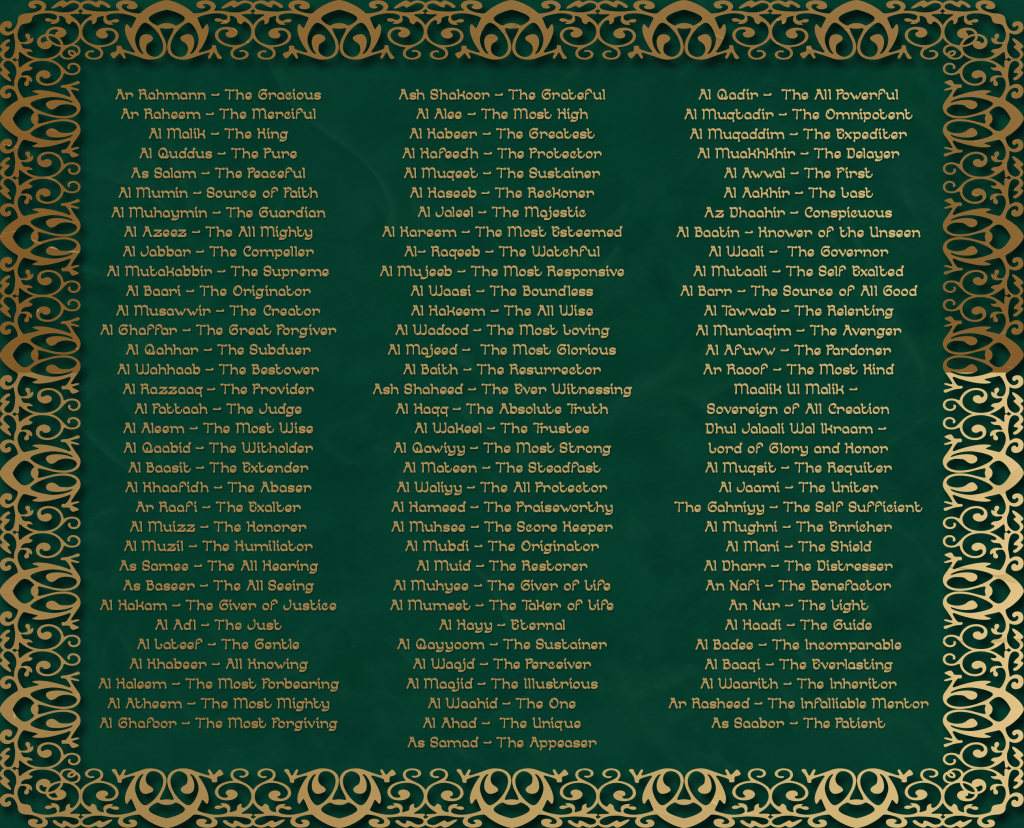
According to Muslim tradition, Allah has 99 names. Devout Muslims repeat these names in a manner similar to that of a Roman Catholic reciting the rosary.
Although Allah possesses the characteristics of power, sovereignty, and majesty, Allah is also characterized by justice and mercy. Allah will repay evil with justice, and righteousness with mercy.
The mercy of God is often emphasized in Muslim worship and practice. It is traditional for a Muslim who is giving a speech or writing to begin with the words, ‘In the name of God, the Merciful and Compassionate.’
 Vault of Stones